
![[North Rule of Fives Star]: In this riddle, the lily pond has a potentially virulent lily that apparently will double in size each day. If the lily grows unchecked it will cover the entire pond in 30 days, choking off all other forms of life in the water by the time it covers the entire pond. If a skeptic waited until 50% of the pond was covered before taking any remedial action to save the pond, when would he act? The answer: on the 29th day of the month! But by then, it would be too late.](https://blogger.googleusercontent.com/img/b/R29vZ2xl/AVvXsEirrxrvNp6Ic1HhfezG41mguabJBD0-CjPpeNOd-WANEL-5t1OrA6go2Dg6b0gOy7KGvISvpFsrbDJSYxaWOs68zUQ1RYfR541_lZHffyOTP2cRuWZfn9CcP6zqvpU7quF9qEekCWzAk_0/s400/storkresources.jpg)
“... World population growth is widely recognized within the Government as a current danger of the highest magnitude calling for urgent measures...... it is of the utmost urgency that governments now recognize the facts and implications of population growth, determine the ultimate population sizes that make sense for their countries and start vigorous programs at once to achieve their desired goals.”
“... population factors are indeed critical in, and often determinants of, violent conflict in developing areas. Segmental (religious, social, racial) differences, migration, rapid population growth, differential levels of knowledge and skills, rural/urban differences, population pressure and the spatial location of population in relation to resources -- in this rough order of importance -- all appear to be important contributions to conflict and violence... Clearly, conflicts which are regarded in primarily political terms often have demographic roots. Recognition of these relationships appears crucial to any understanding or prevention of such hostilities.”
“...there is general agreement that up to the point when cost per acceptor rises rapidly, family planning expenditures are generally considered the best investment a country can make in its own future.”
~ National Security Study Memorandum 200: Implications of Worldwide Population Growth ~
The Inflection Is Near?
By Thomas L. Friedman
Published: March 7, 2009
![[RRR Zhivago Hunter :: Hell Hath No Fury Commons :: Buffalo Bill DMW] US Naval Services Long-Term Study: Global Tipping Points on Food, Water, Energy, Pollution, Population & Natural Resources & The Population Explosion](https://blogger.googleusercontent.com/img/b/R29vZ2xl/AVvXsEhYxD9_Y2JMfbAMnTwsjbXpyE73DRqNpVziT6ZaNXBZOiW4nsri5DdUTwupKd2JvwHYnjaFd8JR2uoYmT37-32ALYVRvufUPPTat36cLsRqLweWtzpB9b75F6YH_FPFhtwXALQaDNnX5Eg/s400/extinction.jpg)
Sometimes the satirical newspaper The Onion is so right on, I can’t resist quoting from it. Consider this faux article from June 2005 about America’s addiction to Chinese exports:
FENGHUA, China — Chen Hsien, an employee of Fenghua Ningbo Plastic Works Ltd., a plastics factory that manufactures lightweight household items for Western markets, expressed his disbelief Monday over the “sheer amount of [garbage] Americans will buy. Often, when we’re assigned a new order for, say, ‘salad shooters,’ I will say to myself, ‘There’s no way that anyone will ever buy these.’ ... One month later, we will receive an order for the same product, but three times the quantity. How can anyone have a need for such useless [garbage]? I hear that Americans can buy anything they want, and I believe it, judging from the things I’ve made for them,” Chen said. “And I also hear that, when they no longer want an item, they simply throw it away. So wasteful and contemptible.”
Let’s today step out of the normal boundaries of analysis of our economic crisis and ask a radical question: What if the crisis of 2008 represents something much more fundamental than a deep recession? What if it’s telling us that the whole growth model we created over the last 50 years is simply unsustainable economically and ecologically and that 2008 was when we hit the wall — when Mother Nature and the market both said: “No more.”
We have created a system for growth that depended on our building more and more stores to sell more and more stuff made in more and more factories in China, powered by more and more coal that would cause more and more climate change but earn China more and more dollars to buy more and more U.S. T-bills so America would have more and more money to build more and more stores and sell more and more stuff that would employ more and more Chinese ...
We can’t do this anymore.
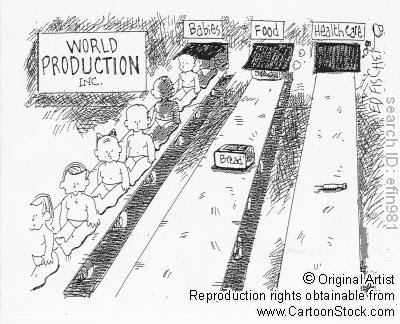
“We created a way of raising standards of living that we can’t possibly pass on to our children,” said Joe Romm, a physicist and climate expert who writes the indispensable blog climateprogress.org. We have been getting rich by depleting all our natural stocks — water, hydrocarbons, forests, rivers, fish and arable land — and not by generating renewable flows.
“You can get this burst of wealth that we have created from this rapacious behavior,” added Romm. “But it has to collapse, unless adults stand up and say, ‘This is a Ponzi scheme. We have not generated real wealth, and we are destroying a livable climate ...’ Real wealth is something you can pass on in a way that others can enjoy.”
Over a billion people today suffer from water scarcity; deforestation in the tropics destroys an area the size of Greece every year — more than 25 million acres; more than half of the world’s fisheries are over-fished or fished at their limit.
“Just as a few lonely economists warned us we were living beyond our financial means and overdrawing our financial assets, scientists are warning us that we’re living beyond our ecological means and overdrawing our natural assets,” argues Glenn Prickett, senior vice president at Conservation International. But, he cautioned, as environmentalists have pointed out: “Mother Nature doesn’t do bailouts.”
One of those who has been warning me of this for a long time is Paul Gilding, the Australian environmental business expert. He has a name for this moment — when both Mother Nature and Father Greed have hit the wall at once — “The Great Disruption.”
“We are taking a system operating past its capacity and driving it faster and harder,” he wrote me. “No matter how wonderful the system is, the laws of physics and biology still apply.” We must have growth, but we must grow in a different way. For starters, economies need to transition to the concept of net-zero, whereby buildings, cars, factories and homes are designed not only to generate as much energy as they use but to be infinitely recyclable in as many parts as possible. Let’s grow by creating flows rather than plundering more stocks.
Gilding says he’s actually an optimist. So am I. People are already using this economic slowdown to retool and reorient economies. Germany, Britain, China and the U.S. have all used stimulus bills to make huge new investments in clean power. South Korea’s new national paradigm for development is called: “Low carbon, green growth.” Who knew? People are realizing we need more than incremental changes — and we’re seeing the first stirrings of growth in smarter, more efficient, more responsible ways.
In the meantime, says Gilding, take notes: “When we look back, 2008 will be a momentous year in human history. Our children and grandchildren will ask us, ‘What was it like? What were you doing when it started to fall apart? What did you think? What did you do?’ Often in the middle of something momentous, we can’t see its significance. But for me there is no doubt: 2008 will be the marker — the year when ‘The Great Disruption’ began.”
Source: New York TimesHow and Why Journalists Avoid the Population-Environment Connection
by T. Michael Maher, University of Southwestern Louisiana
This article is from Population and Environment, Volume 18, Number 4, March 1977![[SufiRRRVilnius :: StratCentMuse :: BBB MonteChristo]The Center for Research on Population & Security, by Stephen Mumford, Ph.D. | CIA & Pentagon on Population & Resource Wars](https://blogger.googleusercontent.com/img/b/R29vZ2xl/AVvXsEhME_QWEeRlDukMkRAy8i0v4_CqlHBTMK4tc05QkfKLLzURLWA11DFrlkuBe9hSRo73PfrfTaGyVXNX60UQe4O1ho8w7M8VZST_zVD9Zd3t9m7bp3HGzYqQ4lbeJNuLVvBEbJkjDvW2Gu0/s400/staythecoursepope.gif)
Recent surveys show that Americans are less concerned about population than they were 25 years ago, and they are not connecting environmental degradation to population growth. News coverage is a significant variable affecting public opinion, and how reporters frame a problem frequently signals what is causing the problem: Using a random sample of 150 stories about urban sprawl, endangered species and water shortages, Part I of this study shows that only about one story in 10 framed population growth as a source of the problem. Further, only one story in the entire sample mentioned population stability among the realm of possible solutions. Part II presents the results of interviews with 25 journalists whose stories on local environmental problems omitted the causal role of population growth. It shows that journalists are aware of the controversial nature of the population issue, and prefer to avoid it if possible. Most interviewees said that a national phenomenon like population growth was beyond the scope of what they could write as local reporters.
INTRODUCTIONIn 1992 the National Academy of Sciences and the British Royal Society issued a joint statement urging world leaders to brake population growth before it is too late (Royal Society, 1992). That same year, 1,600 scientists (including 99 Nobel laureates) issued a statement warning all humanity that it must soon stabilize population and halt environmental destruction (Detjen, 1992). That same year, a Gallup poll showed that Americans were less concerned about population than they had been 20 years before (Newport & Saad, 1992). That same year, world leaders ignored population growth at the largest environmental summit in history, the U.N. Conference on Environment and Development, held in Rio de Janeiro.
Why are the American public and political leaders so indifferent about this issue that so concerns the world's leading scientists and environmentalists? Not because Americans are anti-environment: another recent Gallup Poll (Hueber, 1991), showed that 78% of Americans considered themselves environmentalists and 71 % favored strong environmental protection, even at the expense of economic growth. How can Americans express strong concern about the environment, yet a diminishing concern about population growth, which many environmental experts consider the ultimate environmental problem?
![[Svalbard Seven Samurai :: Seed Armigideon Lohengrin] AGRI-WARFARE: Eating Fossil Fuels, by Dale Allen Pfeiffer, From the Wilderness](https://blogger.googleusercontent.com/img/b/R29vZ2xl/AVvXsEgb796uXhgkOetz9IubVfAAI0ods9ID68bU-wna1fYm_aRyyb9AOyJvPoHbXgHTxfCf_QjQQzJ4ZWW0fUbjdpYYcMCvi92zEc6xxEiWsCzB-kDzHshsZcsf4kzF51o02WUUmAfyXD8UyhI/s400/foodpopulation.jpg)
It seems likely that Americans are not connecting population growth to environmental problems. In addition to the above-cited Gallup poll, a series of nationwide focus groups conducted for the Pew Global Stewardship Initiative confirmed this. The study sought to determine attitudes on population among 10 different voting groups, among them Catholic An- mainstream Protestants, Jewish groups, and environmentalists.
The focus group summary report noted, "The issue of population is not invisible but most often it is a weak blip on the radar screens for most of the voting groups—with the exception of the committed environmentalists and internationalists" (Pew, 1993, p. 22).
Focus groups are ideal for getting beneath the surface of public opinion, for finding out why people think what they think. And most tellingly, when the Pew-sponsored focus groups were evaluated on whether respondents could connect population growth with environmental degradation, environmentalists and some of the internationalists and Jewish men's groups could make the connection, "but overall
most of the others do not make many direct, unaided connections between population and environment," the 1993 Pew report stated (p. 26, italics in the original report).
But why is the American public not making the connection? This paper explores the possibility that news stories, from which Americans may infer causality of environmental problems, may keep them from making the connection between population growth and the problems it causes.
![[Д♠]START:: Pin.2.Gong RUMC.316.H4RO ::STOP[♠Д] US Army War College: People Wars: Ruminations on Population and Security: “How does one say ‘Lebensraum’ in Chinese?”](https://blogger.googleusercontent.com/img/b/R29vZ2xl/AVvXsEgUKUv2GJVFW1O6eToLD5WMzR6uZjqlVqlYnc0L-DfuPEBKeEuySl62x7Ouo9M80Z7TZ5GDhJ_xN8J25S2CdQwFF3mUoVwFC9k4f9lJjY-Xyv16UT2imqafN5KG3A6FK5uGnHK0bAyzZUw/s400/ChinaPopulation.gif)
Population researchers Paul and Anne Ehrlich opened their book, The Population Explosion, with a chapter titled, "Why Isn't Everyone as Scared as We Are?" They acknowledged, "The average person, even the average scientist, seldom makes the connection between [disparate environmental problems] and the population problem, and thus remains unworried" (1990, p. 21). But while they noted that the evening news almost never connects population growth to environmental problems, the Ehrlichs chiefly blamed social taboos fostered by the Catholic Church and Ha colossal failure of education" (p. 32) for public indifference about population. Howell (1992) also minimized the role of the media in influencing public aptitude about science and the environment, and pointed instead to education:
The obvious starting point for the individual is the public schools.... Education proceeds into undergraduate programs, which can play more than one major role in enhancing scientific literacy (p. 1 60)
The Ehrlichs and Howell seem to assume that education is the chief factor driving public opinion about environmental causality. But in
Tradeoffs: Imperatives of Choice in a High-Tech World, Wenk (1986) offered a more media-centric view of how the public learns: "Whatever literacy in science and technology the general public has reached is not from formal education. Rather, it is from the mass media. That responsibility of the press has been almost completely ignored" (p. 162).
This study will examine press responsibility for the public's indifference to population growth by exploring two questions:
- To what extent do press reports about population-driven environmental problems link those problems to population growth?
- What reasons do reporters give for ignoring population growth in stories about environmental problems?
Before discussing method and findings, however, we must first review the theoretical basis for the media's role in molding public opinion.
AGENDA-SETTING AND MEDIA FRAMING THEORY![[Д♠]START:: Armigideon.Nuclear.Titanic ::STOP[♠Д]: Reflections on Sustainability, Population Growth, and the Environment: Carrying Capacity & Denial of Population Problem](https://blogger.googleusercontent.com/img/b/R29vZ2xl/AVvXsEivVkY8Lv55Bp5E6rh97nn_dYryoTrpE1iGhWfC-CFYsZ8il_Iu2XA5956L4fOk6tPDei4wI5oNEnxRapN1ER8VhyF9BI6XZOxz7PrP9629i5aKsekduplHfgb9FEk5E_r0IAOnPRVv1J0/s400/400_MayDayParty-Redbreastedflycatchers.jpg)
Wenk's point that the media are prime movers of public opinion aligns well with recent mass communication scholarship. Scholarly estimation of the power of the media has fluctuated widely during the twentieth century. In the early decades, the mass media seemed to wield great power, as evidenced by the success of the Creel Committee in selling billions in war bonds during World War I, and by the nationwide panic Orson Welles created in his 1938 Halloween hoax broadcast of invasion from Mars. But scholarly estimation of media influence plummeted when
The People's Choice study showed media stories had little influence on a panel of voters and Harrison (1992) argued that environmental impact results from three primary determinants: population, consumption level (sometimes expressed as economic level or affluence) and technology (or resources). This is usually expressed as a formula I = PAT; that is, environmental impact is the product of population, affluence and technology factors. Bailey (1990) reported additional models, POET and PISTOL, which add social organization, information and standard of living to the basic I = PAT model.
With specific reference to habitat loss, Sears (1956), Jackson (1981), Myers (1991), Ehrlich and Ehrlich (1990), Harrison (1992) and many others have shown that population growth pushes people into relatively pristine, natural environments. Endangered species problems are frequently the flip side of this coin: when people convert wildlife habitat to their own habitat, they bulldoze trees, introduce chemicals, channelize streams, build dams, alter the water table, and disrupt habitat in numerous other ways.
While it is well known that environmental experts connect environmental degradation to population growth, it is less well known that land developers are equally straightforward in implicating population growth as a causal agent for turning wildlife habitat and farmland into subdivisions. The how-to manuals for real estate development are very explicit about the critical role of population growth:
The two primary determinants of the need for home and commercial construction are population growth and the demolition and retirement of existing facilities.... Growth in population creates a need not only for housing but also for supporting real estate facilities such as shopping centers, service stations, medical clinics, schools, office buildings, and so on (Goodkin, 1974, p. 14).
The main idea to keep in mind as you search for rewarding corporate realty investments is that in general, land prices are the resultants of population. As more people come on a given section of land, whether to build homes, to work in stores, office buildings, factories, financial institutions, or supermarkets, they create a demand for living space, land and structures. This demand, except during a recession, seems likely to expand indefinitely (Cobleigh, 1971, p. 10).
Demand for real estate at the national level is influenced by national population growth and demographic change, coupled with expanding employment opportunities and rising per capita incomes (McMahan, 1976, p. 76).
Naturally, they frame the results with different language: what land developers might call conversion of raw land to happy communities is often the same phenomenon that environmentalists would call loss of critical wildlife habitat. But both environmentalists and developers agree that population growth is a chief force driving the process of land conversion. Land conversion, in turn, is frequently associated with species decline and urban sprawl, two issues whose news coverage this study examines. A third issue studied in this research, water shortages, is also exacerbated by population growth, according to Postel (1993), Ehrlich and Ehrlich (1990), the Commission on Population Growth and the American Future (1972), Homer-Dixon, Boutwell and Rathjens (1993), Orians and Skumanich (1995) and many other writers.
![[Д♠]S$:: Pin.2.Gong RUMC.316.H4RO ::$S[♠Д] [North Rule of Fives Star]: In this riddle, the lily pond has a potentially virulent lily that apparently will double in size each day. If the lily grows unchecked it will cover the entire pond in 30 days, choking off all other forms of life in the water by the time it covers the entire pond. If a skeptic waited until 50% of the pond was covered before taking any remedial action to save the pond, when would he act? The answer: on the 29th day of the month! But by then, it would be too late](https://blogger.googleusercontent.com/img/b/R29vZ2xl/AVvXsEiMRdzAPtuXV6od-Rkf035SfhzbBl2ydWbzpxsvE1wf-MHnvugHmG3kI7aKGluwNNxmHivPSm9WzMUQU-AdwiYo_lBaJcVWrd-rwvre7GjU4R4xS7c2zfGmffu2A6aaqpLqgBXdQeVt47g/s400/400_twoearthstoicecream.jpg)
We should acknowledge that the cornucopian economists (for example, Simon, 1981; 1990; Bailey, 1993) dispute the notion that population growth has produced any adverse environmental effects. However, their arguments have had much greater predictive power with regard to the short-term price and availability of nonrenewable resources. The cornucopians have failed to explain away the continuing net loss of wildlife habitat, and the growing incidence of water shortages and declining water quality. In general, there is good consensus among the experts that population growth is a significant variable that affects land and water use. But do media reports reflect this?
This is a two-part study. Part I uses content analysis to determine the extent to which reporters include the causal role of population growth in framing stories about the environment. Part II is a follow-up to Part I. It employs depth interviews to discover why reporters ignore the connection between population growth and environmental problems. Since Part I provides the premise for Part Il, its methods and results will be discussed separately.
PART l: HOW REPORTERS FRAME ENVIRONMENTAL PROBLEMSTo measure media framing of environmental stories, Part I uses a randomized sample of 50 articles each for three common population-influ- environmental problems: endangered species, urban sprawl, and water shortages. Articles were downloaded from Lexis-Nexis, the world's largest database of full-text news stories. At the time of the study the Nexis library included 170 newspapers, 330 magazines, as well as wire services. Within Nexis, the CURRENT file limited the search to stories dated 1991 or later. Using the connector "w/2" (e.g., "endangered w/2 species") produced only stories in which the search terms appeared within two words of each other.
![[Population, Resources, and Human Idealism, Energy Bulletin | Population Growth: Most Powerful Force on Earth, Money&Markets] To advocate for human rights, peace, and social justice while ignoring their necessary ecological basis --— a stable human population – at, or slightly less than – the eco-systems long term carrying capacity --- is intellectual dishonesty and hypocrisy.](https://blogger.googleusercontent.com/img/b/R29vZ2xl/AVvXsEhljkaQ3IdsYDlSwhqhtUnur61OFNUIuUgCFkHJkPpL8xPGnZXOzxFfJhTNPxDBODu49hCXKuWfp9l-gQug0wi_EqHClb-iZXZeBXWG1GD0X9D9GQXZCuzB5yP8UHUi6YxWBn6knrpLdx8/s400/ratsbrutalisation.jpg)
The search produced 1,349
water shortage stories, 1,942
urban sprawl stories, and 6,001
endangered species stories. These were sampled by using a random number table. Selected stories were limited to newspaper, magazine and wire service stories from U.S. and Canadian sources. To be considered for coding, the story had to describe a population-driven environmental conflict. (It is now common for various grievance groups to call themselves an endangered species. Such stories were discarded.)
All stories were coded for whether or not population growth was mentioned as a cause of the problem described in the story. A second coder read 30% of the stories from each of the three issues as a reliability check. Coder reliability was 100% because coding news stories for the presence or absence of a reference to population growth is much more reliable than coding stories into abstract, overlapping content categories.
ResultsOf the 150-article sample, 16 (less than 11%) mentioned population growth as a cause of the environmental problem described in the story. Population growth appeared in eight urban sprawl stories, seven water shortage stories, and one story on endangered species. Results are presented in Tables 1, 2, and 3.
Tables 1, 2, and 3 also list solutions mentioned in each story. These solutions are numerically summarized in Table 4. As noted earlier, many experts agree that environmental impact is a product of three primary determinants: population, affluence and technology. If these factors serve as causes, addressing them could serve as solutions. Table 4 analyzes how solutions are framed within the sample of stories.
Tables 1-3 show that population growth is mentioned as a cause in only 10.7% of environmental-problem stories. But population is even more unpopular as an environmental solution: Table 4 shows that from a sample of 150, only one story mentions that a stable population might be a possible solution to environmental problems.

Table 4 suggests that reducing consumption is the favored remedy in stories about endangered species and urban sprawl; but for water shortage problems, technological remedies are higher on the media agenda. In other words, most endangered-species preservation measures entail forbidding consumption of some rare creature's habitat (e.g., ancient forests or springs or desert lands). Likewise, many urban sprawl stories present zoning—legal measures to limit consumption of land—as the chief measure to constrain development of a city perimeter. Such a solution simply dumps the population problem on some other community. But water shortage stories present technological fixes (e.g., new dams, new wells, new pipelines, desalination of sea water) 56% more frequently than reducing consumption.
DiscussionAlthough many scientific groups, environmental scientists and even land development experts agree that population growth is a basic cause of environmental change, media framing diverges widely from expert framing. Just over 10% of a Lexis-Nexis sample of environmental news stories links human population growth to the environmental problems it affects. Even more significantly, only one story in a sample of 150 presents the view that limiting population growth might be a solution to environmental problems. From the standpoint of Americans' environmental future, the most damaging stories might be those that mention population growth as a cause of the problem, while ignoring population stability as a solution. Such stories effectively tell the reader: population growth affects environmental degradation, but population stability is too outlandish even to be mentioned as a policy option.
Ignoring that a stable population might be a longterm solution to environmental problems, news stories instead direct the public's attention to palliative solutions: build new dams to supply water. zone to prevent urban sprawl, set aside land for endangered species.
Given reporters' penchant for proclaiming to "tell both sides," to render all the news that's fit to print, to answer who? what? where? when? and why?, this leads naturally to the question: Why do reporters avoid the population issue so steadfastly?
PART Il: WHY JOURNALISTS AVOID MENTIONING POPULATION
As we have seen, both land development economists and environmental experts acknowledge population growth as a key source of environmental change. But journalists frame environmental causality differently.
Why? Communication theory offers several possibilities. First is the hegemony-theory interpretation: reporters omit any implication that population growth might produce negative effects, in order to purvey the ideology of elites who make money from population growth. As Molotch and Lester (1974) put it, media content can be viewed as reflecting "the practices of those having the power to determine the experience of others" (p. 120). Since real estate, construction and banking interests directly support the media through advertising purchases, this interpretation seems plausible. A number of media critics (e.g., Gandy, 1982; Altschull, 1984; Bennett, 1988) have suggested that media messages reflect the values of powerful political and commercial interests. Burd (1972), Kaniss (1991) and others have pointed out that newspapers have traditionally promoted population growth in their cities through civic boosterism. Molotch (1976) even suggested that cities can best be understood as entities competing for population growth, with the city newspaper as chief cheerleader.
Certainly most reporters would be incensed at the suggestion that they shade their reporting to placate commercial interests. But Breed's classic study of social control in the newsroom (1955) showed that news managers' values are transmissible to journalists through a variety of pressures: salaries, story assignments, layout treatment, editing, and a variety of other strategies that effectively shape news stories in ways acceptable to management.
Another possible explanation for why journalists omit population growth from their story frame is simple ignorance of other explanations. Journalists who cover environmental issues may not be aware of any other possible ways to frame these stories, thus they derive their framing from other journalists. Journalists frequently read each other's work and take cues for coverage from other reporters, particularly from the elite media (Reese & Danielian, 1989). Perhaps the pervasive predictability of the story frames examined in Part I is another example of intermedia influence. On the other hand, it seems difficult to believe that journalists could be ignorant of the role population growth plays in environmental issues, because media coverage frequently ties population growth to housing starts and business expansion. Furthermore, "Why" is one of the five "W's" taught in every Journalism 101 course. A public affairs reporting textbook, Interpreting Public Issues (Griffin, Molen, Schoenfeld, & Scotton, 1991), admonishes journalists: "A common journalistic mistake is simply to cover events—real or staged—and ignore underlying issues" (p. 320). The book identified population trends as one of the "big trouble spots," and listed world population as the first of its "forefront issues in the '90s" (p. 320). Hence, we cannot say that reporting basic causality is beyond the role that journalists ascribe for themselves. Indeed a panel at the 1994 Society of Environmental Journalists discussed "Covering Population as a Local Story" (Wheeler, 1994). But ignorance remains a possible reason, for not all reporters have training in environmental issues.

A third possible explanation comes from the "spiral of silence" theory by German scholar Elisabeth Noelle-Neumann (1984):
The fear of isolation seems to be the force that sets the spiral of silence in motion. To run with the pack is a relatively happy state of affairs; but if you can't, because you won't share publicly in what seems to be a universally acclaimed conviction, you can at least remain silent, as a second choice, so that others can put up with you (p. 6).
According to Noelle-Neumann, "the media influence the individual perception of what can be said or done without danger of isolation" (p. 156). Media coverage legitimates a given perspective. Lack of media coverage—omitting a perspective consistently from media stories—makes the expression of that perspective socially dangerous. Noelle-Neumann also suggested that the media serve an articulation function: "The media provide people with the words and phrases they can use to defend a point of view. If people find no current, frequently repeated expressions for their point of view, they lapse into silence; they become effectively mute" (p. 1 73).
This description fits the national sample of news stories discussed in Part I of this study. These stories often show a double layer of causal myopia. Not only did the journalists not tell readers that population growth was causing the problem, the people in the stories themselves—the sources quoted by the journalists—seemed unaware that their predicament was exacerbated by expanding population. Both the reporters and their subjects seemed to be spiraling in silence. But why would reporters so consistently avoid mentioning population as a causal factor of environmental degradation? After all, journalists are not engaged in some misanthropic conspiracy to dupe the public. But Americans are extremely sensitive to issues involving reproduction, as the continuing furor over abortion demonstrates. Perhaps journalists consider population growth a taboo topic. Journalists' sources, taking their cues from media silence about population, steer clear of the issue themselves.
In
How Do Journalists Think?, Stocking and Gross (1989) offer a cognitive psychology model that suggests that journalists construct hypotheses in pursuing news stories, but that reporters tend to indulge in a host of causal attribution errors. Among these are the tendency to oversimplify, to prefer anecdotal information over more valid statistical information, and the "fundamental attribution error"—the "tendency to weigh personal causal variables more than situational variables" (p. 47). Since population growth is a situational force, this model suggests why journalists might attribute urban sprawl to developers rather than to population growth.
The shallowness of media coverage has attracted scholarly comment as early as Lippmann (1922), who pointed out that journalists must deal in stereotypes because of deadline pressures and readers' preference for simplicity. Many other scholars have commented on the shallow, episodic nature of the news. "The news we are given is not fit for a democracy; it is superficial, narrow, stereotypical, propaganda-laden, of little explanatory value, and not geared for critical debate or citizen action," Bennett (1988, p.9) wrote. Linsky (1988) noted, "The event-orientation of news is a particular problem, for it steers coverage away from ideas and context and does nothing to encourage the drawing of connections between stories" (p. 216).
Entman (1989) identified three production biases common to media stories: 1. simplification—audiences prefer the simple to the complex; 2. personalization—individuals cause events rather than institutional, historical or other abstract forces; 3. symbolization—audiences want dramatic action, intriguing personality, and stirring slogans, and the media provide them. Bennett (1988) offered a similar list of weaknesses in media content: emphasis on people rather than process, and on crisis rather than continuity; isolation of stories from each other, and official assurances of normalcy.
In sum, many existing theories can explain the consistent tendency by journalists to avoid mentioning population growth as a source of the problems they cover. Without further evidence, we really cannot tell. Graber has called for more study on the etiology of content: "Why are particular events selected from the large number of events that might be publicized and why are events cast into particular story frames that supply the interpretive background by which the story is judged?" (1989, p. 146). That is the point of Part I of this study: to find out why journalists neglect the causal role of population growth in framing their articles.
MethodThe author conducted telephone depth interviews with 25 journalists at their work site to determine why they had omitted the causal role of population growth from recent stories they had written. These interviews included several questions asked of all respondents, but also asked the interviewees in an open-ended fashion to comment on the role of journalism in providing information about causality in environmental stories.
The journalists interviewed represented a purposive sample: writers from U.S. newspapers who had done articles accessible in Lexis-Nexis using the same keyword searches used in Part I of this study (endangered w/2 species, water w/2 shortage, urban w/2 sprawl). All interviewees had written the stories under discussion within the preceding six weeks, and all interviewees had omitted population growth from the story frame.
A purposive sample was chosen for several reasons:
- It was necessary to call journalists who had written recently about environmental problems. Journalists are unlikely to be willing or able to discuss details of stories they wrote 18 months ago. Even the current-news library within Lexis-Nexis contains articles so many months old that their details would have been long forgotten by the journalists who produced them.
- The researcher sought a geographic diversity of reporters. Because California (population 31 million) produces so many stories about environmental degradation, and because California newspapers are well-represented in Lexis-Nexis, a randomized sample would likely have yielded a preponderance of California reporters. A purposive geographic selection of journalists produced a more diverse set of perspectives, since the interviewed reporters should represent different educational backgrounds, social circles and within-state political perspectives. A summary of the geographic origin of the interviewed journalists is provided in Figure 1.
- This study does not seek to generalize from the sample to the overall population of reporters, as a probability-sample survey would. It seeks psychological depth rather than sociological breadth, by seeking patterns to reporters' comments about the nature of their work.
As Wimmer and Dominick (1983) suggest in their book on research methods, depth interviews frequently use small purposive samples and a nonstandardized interview format. Hence they lack generalizability. But this chapter seeks to glean information about sensitive subjects—possibly, journalistic taboos—and for that purpose depth interviews are ideal.
Interview Format
In opening the discussion, the researcher identified himself and stated the study was about how journalists depict causality in environmental stories. The researcher assured the journalists that they would not be identified in any report resulting from the study. After mentioning that he had obtained their stories and bylines through a Lexis-Nexis scan, the researcher recounted a few details of each writer's story to establish common ground with the respondent. The researcher then asked an open-ended question: "What would you say was the cause of [the problem discussed in your story]?" If this answer produced no mention of population, the researcher asked a second open-ended question: "Can you think of any other causes? Perhaps at a deeper level of causation?"
If two open-ended questions produced nothing about the causal role of population growth, the researcher volunteered it by saying: "Many environmental writers say that population growth is one of the ultimate causes of environmental problems like [the problem discussed in the story]. Do you think that's true in your story?" If the journalist agreed that population growth was indeed a causal factor (but had not volunteered such information unaided), this offered two possible interpretations: either the journalist was not well attuned to the environmental effects of population growth, or the journalist felt the subject was too controversial to broach (a spiral of silence effect). Further questioning sought to clarify how the writer stood on the issue. If the writer showed familiarity with the population issue, this was taken as evidence of a viral of silence effect. If the journalist seemed unaware of a connection between population growth and environmental problems, this was interpreted as lack of knowledge.
If the respondent implicated population growth in either open-ended question, or in agreement with the researcher's suggestion, the researcher then asked: "Would it have been out of place to have mentioned this in your story?"
The researcher then sought to determine why the reporter had omitted population growth in framing the story. The researcher also sought the respondent's views on the population-environment connection, and the role of journalism in informing the public of causality in reporting environmental problems. One other standard question for each interview was: "If you had interviewed a source for the story in question, and that source had implicated population growth as a source of the problem, would you have used that quote?"
ResultsThe interviews produced little support for the "ignorance hypothesis"—the possibility that journalists are unaware of the causal role of population growth in precipitating local environmental problems. In response to an open-ended question, eight of the 25 volunteered that population growth was a source of the problems they wrote about. Eleven more agreed that population was a likely cause, when the researcher offered the idea. These 11 had the benefit of aided recall, but only two of them seemed to be unfamiliar with the population-environment connection.
Six interviewees discounted that population was a major factor in the problem they had described in their stories—and they were possibly correct, within their immediate environmental context and time frame. Areas with stable or even declining populations can still experience pressure on land and water resources through increased consumption; for example, a large cohort of baby boomers might attain affluence sufficient to build new homes on larger lots or buy second homes.
Generally, though, the surveyed reporters seemed aware of the role that population growth played in precipitating environmental problems.
The interviews gave little evidence of any "hegemony theory" effect. That is, reporters made no mention of being influenced by real estate advertisers or other powerful interests. But this is to be expected, since hegemony theory postulates that reporters" obeisance to the dominant ideology is unconscious and unexamined. A study of this nature, which relies on self-reportage of motives, would be unlikely to reveal hegemonic effects.
The interviews show some evidence for the "spiral of silence" explanation: many interviewed reporters felt that population is a hot issue, better left unmentioned. Several reporters volunteered this in conversation. One recalled the controversy that ensued when the Philadelphia Enquirer advocated Norplant as a solution for local teen pregnancy, which created charges of racism by area black people. Another reporter admitted of population, "It's such an incendiary issue. If you say, 'It all comes down to too many people,' you'll have everybody from Operation Rescue to the Catholic Church calling you." Another said, "We as journalists are nervous to discuss population." Another admitted, "Most of us [reporters] wait until somebody says it." In other words, the reporter felt he could not broach the issue in an interview without recriminations. This last statement implies that a spiral of silence is at work. Many journalists interviewed for this study felt the population issue was too controversial for them to bring up in an interview. The media are commonly acknowledged to serve as legitimizers for what can be said safely (Berger & Luckmann, 1966; Gans, 1979; Noelle-Neumann, 1984). But these interviews suggest that reporters themselves are affected by possible negative repercussions from pressure groups. Thus a spiral of silence about population growth may be maintained by determined pronatalists, immigration advocates, and intimidated journalists.
Further evidence of a spiral of silence is the fact that several reporters who did not volunteer population growth as a cause of local problems in response to open-ended questions subsequently admitted deep concern about population. After the researcher broke the silence and mentioned that some environmental writers feel population growth drives environmental problems, many interviewees who had not volunteered such a perspective in an open-ended format voiced similar feelings. One woman reporter mentioned that she had chosen not to have children in part from environmental concerns—yet she did not mention population as an environmental variable when asked an open-ended question. Two other journalists who avoided mentioning population in response to open-ended questions later said they address population every few months in stories. Both were quite familiar with details of the issue. But they did not initially volunteer that familiarity to the interviewer.
Finally, of course, none of the interviewees had mentioned population in the stories they wrote. Such a discrepancy indicates that reporters are not putting all they know about causality into their story frame. As Noelle-Neumann put it, it is easier to remain silent and run with the pack. But the taboo nature of population growth was not the chief reason journalists mentioned for avoiding the issue in their reportage. Instead, most said population was simply beyond the bounds of their story.
The Narrative Imperative and Causal Dissociation
The reason journalists most consistently mentioned for avoiding the population issue was not anticipated in the researcher's initial series of questions. That is, when asked to comment on why they had omitted population growth from their story, most interviewed journalists said that population growth simply did not fit within the event frame that served as their news peg.
Many writers (Bennett, 1988; Entman, 1989; Hart, 1987; Gans, 1979) have commented on journalists' preference for the dramatic over the explanatory, the personal over the situational. Many others have commented on the need for journalism to compress complex reality into narrative form (Darnton, 1975; Paletz, Reichert, & McIntyre, 1971). In her study of the sociology of newswork, Tuchman (1978) focused on organizational forces as prime mover of the news product, but she admitted that story forms have considerable power to shape the news:
Attributing to news narratives the power to raise certain questions and to ignore others may seem to digress from this book's argument. Rather than demonstrate that news is a product of specific ways of organizing newswork, it suggests that the formal characteristics of the product of newswork guide inquiry. The power of forms cannot be dismissed (p. 104).
McCartney (1987) even applied a centuries-old typology of fictional conflict situations to journalistic stories, and discovered that many classic conflict forms could be discovered in modern journalistic stories.
McCombs, Einsiedel, and Weaver (1991) suggested that news is shaped by journalists' training, by bureaucracies of news organizations, and also by "the traditions of journalism as a genre of mass communication" (p. 26). They added that structural biases "arise from the very nature of journalistic reporting and writing. The narrative styles of journalism shape the configuration of facts reported in the news" (p. 30). They added, "To a considerable degree, what each reporter sees is framed by the genre in which he or she writes" (p. 34).

This narrative imperative of news pushes an invisible, slow, impersonal social force like population growth out of the story frame. If they ascribe blame for, say, urban sprawl, journalists tend to blame visible, personal causes—e.g., land developers—without ever questioning the social and economic forces that make it profitable for land developers to replace forest with suburb. If they ascribe blame for water shortages, journalists tend to blame Mother Nature: when will the drought end?
The working principles of storytelling create causal myopia in news stories. Daily events reporting must have a news peg, an event that gives the writer premise for writing the story. In terms of space and time, the story must be framed fairly tightly around the event. Reporters cannot "go global" with a local story, for their space is limited in column inches to tell the story. Many of the interviewed reporters commented on this limitation when discussing their role as local journalists. Each of the following comments is from a different journalist:
- "When you come to something like population growth, it's difficult for a community to say, 'We want to take on population growth.' It was staying close to the event. If it were a big feature on what [my area] is going through, then it would make sense to discuss population."
- "My story was more of a historical piece [on how a small community had changed]. For that approach [a discussion of population growth] wouldn't have worked."
- "Often daily journalism doesn't include the broad context; you find that in the op-ed pages. Journalists are self-conscious about appearing intellectual; they don't want to appear self-indulgent."
- "It's difficult to think you're going to have a forum as a local reporter to talk about a global issue like population."
- "The press tends to be crisis-oriented and has a hard time getting a handle on issues that are big."
- "I don't think globally when I write a story; I think, 'what do the people in this town want to know about?'"
- "It's not journalists who are the problem [for omitting causality]. It's the editors. They don't want us to challenge the reader with unpopular ideas."
- "It is the role of journalists to include population growth as a source of problems. But on a daily story, you can practically never do that. On a daily story, it's almost impossible. If I were to try, my editor would probably want me to spend more time defining terms, and we don't have space for that."
- "Population doesn't ring a bell with me in the realm of causality. Maybe on the global picture, but in terms of a developer putting in a golf course, no."
- "I've got 20 inches to explain why a garter snake is endangered. There's no room for population growth in the story. Sometimes I write about population in general terms."
- "Population is beyond this story as far as I have learned. We sometimes address the population issue on its own terms."
- "The global perspective is not out of line, it's just not what got me into this story. This was more about politics than the environment."
- "[Mentioning population] probably requires a look at the bigger picture, a more national scope. As [newspaper] space becomes constricted overnight and editors were looking for places to cut, [population] would be the first thing to go."
- "The immediate problem was the drought. They [local officials] were just waiting to see what happened. Population didn't play into that story. We cover fires, basically. You come back later on—about once every six months—and say, here's the trend. But you've got so many other topics."
- "Population as a topic is not a taboo; we have done stories on population in the past. It is a matter of stopping to think about it when you write a story. This [story in question] was written in about an hour on a laptop in my kitchen about 10 p. m., and it's not one of my best efforts."
- "I don't know that you can get [population] into the story. There are space limitations and the conventions of journalism are such that you have to keep your paragraphs germane to one another. If you're talking about wildlife habitat and then all of a sudden you're talking about world population growth, you've gotta explain to an editor how you got there and use a lot of paragraphs to do that."
- "Maybe Americans have a reluctance to talk about [population]. I don't know when, if ever, they'll be ready. Maybe the next generation will actually bring up population as a topic for discussion."
The implications are clear from these quotes. Local journalism cannot easily connect community events to slow, impersonal national or global causes. Even those interviewed journalists who were very savvy on environmental issues, who were very aware of the effects of population growth, admitted that including it in event-driven stories is frequently impossible. Space limitations are always a concern, and editors do not tolerate journalists' straying too far from the story line.
Although depth interviews lack generalizability, they are indeed useful in exploring sensitive issues of journalists' motivation and intention. Naturally, self-reporting cannot capture all of journalists' reasons for why they frame stories in a given manner. People cannot verbalize every motive for what they do. But the interviewed journalists showed considerable consensus in suggesting that population growth is too broad to fit in a story framed tightly around a local environmental problem. Most respondents were acutely aware of the boundaries separating local and national reporting, and what this means for the work they do. Taking a national perspective on a controversy over a local land development would be seen as egotistical, intellectual, and beyond the journalist's job description.
However, despite the forces constraining journalists from mentioning population growth, environmentalists may have an opportunity to affect causal framing of environmental problems. When asked whether they would use a quote connecting environmental problems to population growth, if their sources offered such a perspective, 16 journalists interviewed for this study indicated they would. Five said they would probably not include such a perspective, and four were unsure, allowing that their framing would depend on the context of the story.
 The symptoms of overpopulation colliding with finite or scarce resources (i.e. ecological overshoot resource wars) include: energy depletion, food shortages, species extinction, politically correct fascism, Immigration and emigration, terrorism, starvation, poverty, disease, crime, economic & political instability, pain and misery... Population Policy Common Sense |
This means that environmentalists have the opportunity to break the media's silence about population and help connect population growth to the problems it causes, if they will take the initiative to raise the subject with journalists who cover local environmental issues. Environmentalists should understand that most reporters do not consider it their role to broach the population issue. As one interviewed journalist admitted of the population connection, "Most of us [reporters] wait until somebody says it." Another reporter said, "If someone were intelligent enough to mention population, I would mention it [in the story]." Yet another comment was, "Unless the journalist runs across the right expert who says, 'It's population,' the tendency is not to put it in [the story], unless you've been assigned to write a major series." However, as one interviewed reporter commented, "No one ever mentions population growth as a source of the problem." Another said, "No one has talked about limiting demand [for housing]. Officials in these small towns are pretty shortsighted."
DISCUSSION The symptoms of overpopulation colliding with finite or scarce resources (i.e. ecological overshoot resource wars) include: energy depletion, food shortages, species extinction, politically correct fascism, Immigration and emigration, terrorism, starvation, poverty, disease, crime, economic & political instability, pain and misery... Population Policy Common Sense |
In thousands of communities across America, population growth is wreaking changes: a mobile home park displaces an orchard, a farmer loses his water rights to a city hundreds of miles away, an endangered reptile's last known habitat is threatened by a subdivision. These and countless other population-influenced disruptions reduce wildlife habitat, rural solitude, water availability, and many other environmental qualities. But this study shows that only one news story in 10 connects these events to domestic population growth.
This study suggests that the working principles of journalistic storytelling create a vast causal dissociation when the news media report population-driven environmental problems. Local media can cover local environmental degradation, but cannot connect these problems to population growth because, in part, reporters and their sources feel that population growth can only be addressed at the national level. National media can address the population issue, but national reporters cannot peg a story on population to local events that, from a national perspective, seem trivial. Why would Newsweek readers in Iowa or Oregon want to know about population-driven water rationing in a suburb of San Diego, or a protested land development north of Atlanta? And on the other hand, why would a borough of Boston want to address national population growth as an issue? From a systems theory perspective, the information feedback loop that connects the microcosm to the macrocosm is broken in the news we get.
A spiral of silence also seems to affect journalists' framing of population-driven environmental problems. Most journalists interviewed in this study knew population growth affects the environment they cover, but they were reluctant to mention population either in their stories or in the interviews that formed the basis for this chapter. Reporters know the controversial nature of population growth, and would rather avoid the issue than mention it—even in questioning sources for their stories.
This study suggests that, from an agenda-setting perspective, the narrative imperative of newswriting keeps issues like population off the agenda. Frequency of mention by the media is the chief means by which an issue asserts itself into the public consciousness (McCombs & Shaw, 1977). But even though population growth causes or exacerbates uncountably frequent events that lower the quality of most Americans' lives, reporters do not mention this. They cannot connect event to ultimate cause in daily events reporting, and this effectively keeps the cause off the agenda and out of public consciousness. If, as one interviewed reporter suggested, reporters "cover fires" for six months, then write a single "trend story" that connects the events to causes, this pattern likely keeps population low on the agenda, because an isolated trend story is unlikely to have much effect on public consciousness.
McCombs and Shaw (1977) note that the media serve a useful function by setting the agenda:
Both by deliberate winnowing and by inadvertent agenda-setting the mass media help society achieve consensus on which concerns and interests should be translated into public issues and opinion (pp. 151 -152).
But the agenda-setting process seems useful only if we consider what the media
do place on the agenda. This study shows that agenda-setting may have a dark side, when we consider what the media
do not cover. To generalize from this study, it seems likely the media have a blind spot regarding the basic layers of multilayered causality. The deep causes that drive daily events remain off the agenda. Certainly this is the case with population growth, but such causal dissociation may keep many other deep-seated causes of social problems off the agenda.
Although scholars have not satisfactorily tied the media agenda and public opinion to the policy agenda (Borquez, 1993), many scholars have agreed that the media are very important for determining what does not get on the policy agenda. Spitzer (1993) noted: "The scope of the conflict determines the outcome . . . more than any other single force in national politics, the media control the scope of politics." In a similar vein Kingdon (1973) said: "In addition to noting how important the media are in bringing subjects, facts, and interpretations to congressmen, it is also important to mention that the media also play some part in determining which pieces of information will not be brought to congressmen." Indeed, recent U.S. policy on population is pronatalist (Abernathy, 1993). And although in 1996 Congress took measures to reduce illegal immigration, it did so primarily for economic and social reasons, rather than out of concern for the environment. That same Congress dramatically reduced U.S. funding for worldwide family planning programs.
Many environmentalists are frustrated by the low salience Americans give the population issue. Deploring the "primitive stage" of U.S. public opinion on population, Grant (1992, p. 231) characterizes U.S. political discourse as "the kingdom of the deaf" (p. 239). Part t of this study shows that the American public is not deaf; but in the news they read, Americans simply have little to hear that explains the environmental costs of population growth. Well-known population researcher Paul Ehrlich has written that a "conspiracy of silence" keeps humanity from taking action on population (1989). Part II of this study shows that journalists are engaged in no conspiracy; they are simply keeping within the storytelling bounds of their craft, framing their coverage of environmental issues narrowly with regard to space and time. Interviewed journalists feel that a limited newshole keeps them from connecting local environmental problems to global causes like population growth and immigration into the United States. They also know that reproductive matters are a hot button with some readers, and steer clear of the issue if they can.
But population must become more salient if future generations are to enjoy the quality of life we now know. A number of scholars conversant with sustainable levels of agricultural and energy output recently estimated an optimum population for the United States (Pimentel & Pimentel, 1992; Constanza, 1992; Ehrlich & Ehrlich, 1992; Werbos, 1992). The highest estimates were below current population levels; several low estimates were for a U.S. population of less than 100 million. Meanwhile the population of the United States is 265 million and is growing about 1 % a year.
Walter Lippmann (1922) distinguished news from truth: "The function of news is to signalize an event, the function of truth is to bring to light the hidden facts, to set them into relation with each other, and make a picture of reality on which men can act" (p. 226). This study shows how and why we are letting signalized events, rather than truth, set the agenda for our demographic and environmental future.
REFERENCES (See Word Version)
Source: DieOff [Download: Media's Population Agenda & 'War on Terror' Outcome: HOW & WHY Journalists Avoid Population-Environment Connection, by T. Michael Maher; Univ. of SW Louisiania (Word: 153 KB)]


![[Д♠]SS:: Yshmael.Jyewrineville.Guerryllas ::SS[♠Д]](https://blogger.googleusercontent.com/img/b/R29vZ2xl/AVvXsEhCux_1zvtXtCXUU1g45SmuhcerGbfqJWE6y6EvENeBIQRw332v-_CgJAArYce0GSray6cTKujiqUDapLcBrZRLz4H6jKF_On40Gfd6mHYsNzE7zoeGPJTTobiAb7VgZBKgIwBAsdWpV5w/s400/samlookingforyou.jpg)


