Note to Readers:

Please Note: The editor of White Refugee blog is a member of the Ecology of Peace culture.

Summary of Ecology of Peace Radical Honoursty Factual Reality Problem Solving: Poverty, slavery, unemployment, food shortages, food inflation, cost of living increases, urban sprawl, traffic jams, toxic waste, pollution, peak oil, peak water, peak food, peak population, species extinction, loss of biodiversity, peak resources, racial, religious, class, gender resource war conflict, militarized police, psycho-social and cultural conformity pressures on free speech, etc; inter-cultural conflict; legal, political and corporate corruption, etc; are some of the socio-cultural and psycho-political consequences of overpopulation & consumption collision with declining resources.

Ecology of Peace RH factual reality: 1. Earth is not flat; 2. Resources are finite; 3. When humans breed or consume above ecological carrying capacity limits, it results in resource conflict; 4. If individuals, families, tribes, races, religions, and/or nations want to reduce class, racial and/or religious local, national and international resource war conflict; they should cooperate & sign their responsible freedom oaths; to implement Ecology of Peace Scientific and Cultural Law as international law; to require all citizens of all races, religions and nations to breed and consume below ecological carrying capacity limits.

EoP v WiP NWO negotiations are updated at EoP MILED Clerk.
Showing posts with label [Д♠] Peak Oil. Show all posts

Saturday, September 1, 2012

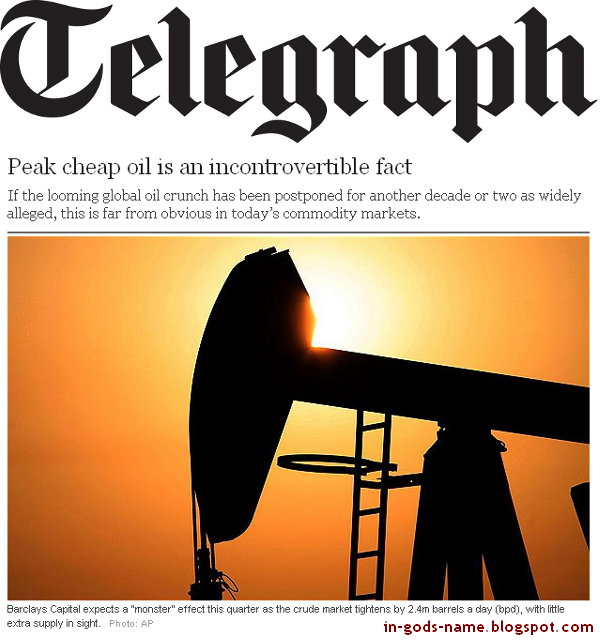
Goldman Sachs & Barclays Capital: Peak cheap oil is an incontrovertible fact


Peak cheap oil is an incontrovertible fact

Comment: Mr. Evans-Pritchard is clueless that 'Peak Oil' means 'the end of cheap oil'; which is shocking ignorance. Energy Return on Energy Invested (EROI) explains how and why there can be ten trillion barrels deep under the ground, but if it requires more than one barrel of oil, to dig up another barrel of oil; there is no return on investment/i.e. it is an energy sink: fucking pointless!

Ambrose Evans-Pritchard | Telegraph | 26 Aug 2012

Brent crude jumped to $115 a barrel last week. Petrol costs in Germany and across much of Europe are now at record levels in local currencies.

Diesel is above the political pain threshold of $4 a gallon in the US, hence reports circulating last week that the International Energy Agency (IEA) is preparing to release strategic reserves.

Barclays Capital expects a “monster” effect this quarter as the crude market tightens by 2.4m barrels a day (bpd), with little extra supply in sight.

Goldman Sachs said the industry is chronically incapable of meeting global needs. “It is only a matter of time before inventories and OPEC spare capacity become effectively exhausted, requiring higher oil prices to restrain demand,” said its oil guru David Greely.

This is a remarkable state of affairs given the world economy is close to a double-dip slump right now, the latest relapse in our contained global depression.

Britain, the eurozone, and parts of Eastern Europe are in outright recession. China has “hard-landed”, the result of a monetary shock and real M1 contraction last winter. The HSBC manufacturing index fell deeper into contraction in July.

Friday, May 4, 2012

Error in Bridgewater Publication: A Template for Understanding Whats Going On: How the Economic Machine Works: Disregard for Peak Oil and Peak Non-Renewable Natural Resources as the Ecological Foundation of Economic and Political Reality


Peak Oil/NNR Error in Bridgewater Publication: T4U: How Economic Machine Works

RE: Error in Bridgewater Publication: A Template for Understanding Whats Going On: How the Economic Machine Works: Disregard for Peak Oil and Peak Non-Renewable Natural Resources as the Ecological Foundation of Economic and Political Reality


From: Lara Johnstone
Sent: Sunday, April 29, 2012 9:38 PM
To: US: BWater: Paul Darrah; US: BWater: Joel Whidden; US: BWater: Jim White; US: BWater: Kylee Gioiele; US: BWater: Chris Mascarinas
Cc: Dick Smith; Presidency: Dumisa Jele - Ch. Of Staff; Minister of Planning: Ellen Mabunda - Pers. Asst; Min of Finance/Treasury: Lindani Mbunyuza; Treasury: Kershia Singh;
Subject: Peak Oil/NNR Error in Bridgewater Publication: T4U: How Economic Machine Works

CEO: Ray Dalio
Bridgewater Associates
One Glendinning Place
Westport, CT 06880
c/o BWater Employees

CC: (Radical Transparency) Minister of Finance: Mr. Pravin Gordhan; National Strategic Planning Commission: Mr. Trevor Manuel
CC: Peak Oil Org's & Individuals

Dear Mr. Dalio,

RE: Error in Bridgewater Publication: A Template for Understanding Whats Going On: How the Economic Machine Works: Disregard for Peak Oil and Peak Non-Renewable Natural Resources as the Ecological Foundation of Economic and Political Reality

On 08 April I wrote you an email wherein I informed you of my opinion that there is an error in your Bridgewater Associates publication: A Template for Understanding Whats Going On[1]. Specifically that your No.1 Trend Line Productivity Graph was incorrect.

I stated that your graph was a ‘small picture’ graph, and that if you had a ‘big picture’ reality perspective, your graph would look more like that of Mr. Chris Clugston in his Peak NNR book: Scarcity: Humanity’s Last Chapter: A Comprehensive Analysis of Nonrenewable Natural Resource (NNR) Scarcity’s Consequences.

Put succinctly: (I) Peak Oil & Peak Non-Renewable Resources = End of Economic Growth (II) Sustainable Economic Growth is an Oxymoron; (III) Ecological Sustainability = (A) Urgent Population & Consumption Reduction, (B) Political Secession & Economic Relocalisation

I have not received a response from you or anyone at Bridgewater Associates to inform me whether you enquired into the information provided to your offices and what conclusions you reached based upon your enquiry.

Attached PDF includes information on above Peak Oil and NNR realities as well as philosophical perspectives to Masculine (Reason and Logic) Insecurity EgoCentric Denial of the Impending Collapse of Industrial Civilisation.

I am aware of the fact that your -- Daily Observations -- Newsletter is "one of the most widely forwarded pieces of market analysis" read by "practically everyone who is anyone on the Street", including "leaders of central banks, managers of global pension funds as well as U.S. Treasury Secretary Timothy Geitner and President Barack Obama."[2]

Thursday, May 3, 2012

Error in Bridgewater Publication: A Template for Understanding Whats Going On: How the Economic Machine Works: Disregard for Peak Oil and Peak Non-Renewable Natural Resources as the Ecological Foundation of Economic and Political Reality


Peak Oil/NNR Error in Bridgewater Publication: T4U: How Economic Machine Works

RE: Error in Bridgewater Publication: A Template for Understanding Whats Going On: How the Economic Machine Works: Disregard for Peak Oil and Peak Non-Renewable Natural Resources as the Ecological Foundation of Economic and Political Reality


From: Lara Johnstone
Sent: Sunday, April 29, 2012 9:38 PM
To: US: BWater: Paul Darrah; US: BWater: Joel Whidden; US: BWater: Jim White; US: BWater: Kylee Gioiele; US: BWater: Chris Mascarinas
Cc: Dick Smith; Presidency: Dumisa Jele - Ch. Of Staff; Minister of Planning: Ellen Mabunda - Pers. Asst; Min of Finance/Treasury: Lindani Mbunyuza; Treasury: Kershia Singh;
Subject: Peak Oil/NNR Error in Bridgewater Publication: T4U: How Economic Machine Works

CEO: Ray Dalio
Bridgewater Associates
One Glendinning Place
Westport, CT 06880
c/o BWater Employees

CC: (Radical Transparency) Minister of Finance: Mr. Pravin Gordhan; National Strategic Planning Commission: Mr. Trevor Manuel
CC: Peak Oil Org's & Individuals

Dear Mr. Dalio,

RE: Error in Bridgewater Publication: A Template for Understanding Whats Going On: How the Economic Machine Works: Disregard for Peak Oil and Peak Non-Renewable Natural Resources as the Ecological Foundation of Economic and Political Reality

On 08 April I wrote you an email wherein I informed you of my opinion that there is an error in your Bridgewater Associates publication: A Template for Understanding Whats Going On[1]. Specifically that your No.1 Trend Line Productivity Graph was incorrect.

I stated that your graph was a ‘small picture’ graph, and that if you had a ‘big picture’ reality perspective, your graph would look more like that of Mr. Chris Clugston in his Peak NNR book: Scarcity: Humanity’s Last Chapter: A Comprehensive Analysis of Nonrenewable Natural Resource (NNR) Scarcity’s Consequences.

Put succinctly: (I) Peak Oil & Peak Non-Renewable Resources = End of Economic Growth (II) Sustainable Economic Growth is an Oxymoron; (III) Ecological Sustainability = (A) Urgent Population & Consumption Reduction, (B) Political Secession & Economic Relocalisation

I have not received a response from you or anyone at Bridgewater Associates to inform me whether you enquired into the information provided to your offices and what conclusions you reached based upon your enquiry.

Attached PDF includes information on above Peak Oil and NNR realities as well as philosophical perspectives to Masculine (Reason and Logic) Insecurity EgoCentric Denial of the Impending Collapse of Industrial Civilisation.

I am aware of the fact that your -- Daily Observations -- Newsletter is "one of the most widely forwarded pieces of market analysis" read by "practically everyone who is anyone on the Street", including "leaders of central banks, managers of global pension funds as well as U.S. Treasury Secretary Timothy Geitner and President Barack Obama."[2]

Tuesday, December 27, 2011

Peak Oil & Peak Non-Renewable Resources = End of Economic Growth; Ecological Sustainability = (A) Urgent Population & Consumption Reduction


(I) Peak Oil & Peak Non-Renewable Resources = End of Economic Growth (II) Sustainable Economic Growth is an Oxymoron; (III) Ecological Sustainability = (A) Urgent Population & Consumption Reduction, (B) Political Secession & Economic Relocalisation


“If each human family were dependent only on its own resources; if the children of improvident parents starved to death; if thus, over breeding brought its own "punishment" to the germ line -- then there would be no public interest in controlling the breeding of families. But our society is deeply committed to the welfare state, and hence is confronted with the tragedy of the commons.” -- Tragedy of the Commons, Garret Hardin; Armigideon Knights

“In this riddle, the lily pond has a potentially virulent lily that apparently will double in size each day. If the lily grows unchecked it will cover the entire pond in 30 days, choking off all other forms of life in the water by the time it covers the entire pond. If a skeptic waited until 50% of the pond was covered before taking any remedial action to save the pond, when would he act? The answer: on the 29th day of the month! But by then, it would be too late.” - Kaffir Lily Riddle

“The composition of the Greens seems to be the same as that of the population in general — mainly pieces of drifting wood, people who never think.” -- Pentti Linkola

“What to do, when a ship carrying a hundred passengers suddenly capsizes and there is only one lifeboat? When the lifeboat is full, those who hate life will try to load it with more people and sink the lot. Those who love and respect life will take the ship's axe and sever the extra hands that cling to the sides.” -- Pentti Linkola

“The economists all think that if you show up at the cashier's cage with enough currency, God will put more oil in ground.” - Kenneth S. Deffeyes, Geologist


ENERGY: FOUNDATION OF ECONOMIC GROWTH

Energy Production & Gross Domestic Product (GDP)


Energy and Economic Growth, by David I. Stern, Department of Economics, Rensselaer Polytechnic Institute:
This article surveys the relation between energy and economic growth and more generally the role of energy in economic production. While business and financial economists pay significant attention to the impact of oil and other energy prices on economic activity, the mainstream theory of economic growth pays little or no attention to the role of energy or other natural resources in promoting or enabling economic growth. Resource and ecological economists have criticised this theory on a number of grounds, especially the implications of thermodynamics for economic production and the long-term prospects of the economy. While a fully worked out alternative model of the growth process does not seem to exist, extensive empirical work has examined the role of energy in the growth process. The principal finding is that energy used per unit of economic output has declined, but that this is to a large extent due to a shift in energy use from direct use of fossil fuels such as coal to the use of higher quality fuels, and especially electricity. When this shift in the composition of final energy use is taken into account energy use and the level of economic activity are found to be tightly coupled. When these and other trends are taken into account the prospects for further large reductions in the energy intensity of economic activity seem limited. The implications for environmental quality and economic sustainability are discussed.

Saturday, March 5, 2011

Humans: An Endangered Species: [V] A Proposal: How to Determine Who Can and Who Cannot Reproduce


HUMANS: AN ENDANGERED SPECIES

BY JASON G. BRENT

Copyright by Jason G. Brent
Jan. 1, 2008, Jan.1, 2009, and July 17, 2010


  1. Introduction
  2. The Book Begins
  3. Smart Growth, Dumb Option
  4. Recycling has its limits
  5. Space Travel Not the Answer
  6. The Power of Compound Growth
  7. Declining Growth Rates Mask a Coming YouthQuake
  8. The Exploding Growth of the Indian Sub-Continent
  9. Gambling Our Future on Statistical Projections
  10. There Isn't any Fix for Perpetual Growth
  11. At Most the Earth Could Support One Billion on an American Life Style
  12. Doubling the Economic Output of the Planet Just to Stay Even
  13. The World Will Not Be Big Enough for Both Resource Hogs -- China and the United States of America
  14. Humanity Cannot Afford to Gamble on Voluntary Population Control
  15. Terrorists and the Power of Weapons of Mass Destruction
  16. Religion -- A Potent Force Against Population Stabilization
  17. Universal Voluntary Birth Control -- A Pipe Dream Humanity Cannot Afford
  18. The Delusional Expectations of Technological Solutions
  19. Environmentalism Fails to Address the Root Cause
  20. Triage Ethics -- Conventional Morality or Human Survival?
  21. The Exhaustion of Oil -- A Death Sentence for Billions
  22. Water Shortages
  23. Easter Island - A Lesson Which Humanity Must Heed
  24. Destruction of Productive Land and Destruction of Fisheries
  25. The Compound Effect of Extended Life Expectancies
  26. There Cannot be Any Procreative “Rights” in an Overpopulated World
  27. Shocking Proposals
  28. A Proposal as to How to Determine Who can and Who Cannot Reproduce
  29. The Leaders of Humanity by their Inaction Will Kill Billions of Humans


THERE CANNOT BE ANY PROCREATIVE “RIGHTS” IN AN OVERPOPULATED WORLD


Friday, March 4, 2011

Humans: An Endangered Species: [IV] Easter Island Lesson: Peak Resources: A Death Sentence for Billions


HUMANS: AN ENDANGERED SPECIES

BY JASON G. BRENT

Copyright by Jason G. Brent
Jan. 1, 2008, Jan.1, 2009, and July 17, 2010


  1. Introduction
  2. The Book Begins
  3. Smart Growth, Dumb Option
  4. Recycling has its limits
  5. Space Travel Not the Answer
  6. The Power of Compound Growth
  7. Declining Growth Rates Mask a Coming YouthQuake
  8. The Exploding Growth of the Indian Sub-Continent
  9. Gambling Our Future on Statistical Projections
  10. There Isn't any Fix for Perpetual Growth
  11. At Most the Earth Could Support One Billion on an American Life Style
  12. Doubling the Economic Output of the Planet Just to Stay Even
  13. The World Will Not Be Big Enough for Both Resource Hogs -- China and the United States of America
  14. Humanity Cannot Afford to Gamble on Voluntary Population Control
  15. Terrorists and the Power of Weapons of Mass Destruction
  16. Religion -- A Potent Force Against Population Stabilization
  17. Universal Voluntary Birth Control -- A Pipe Dream Humanity Cannot Afford
  18. The Delusional Expectations of Technological Solutions
  19. Environmentalism Fails to Address the Root Cause
  20. Triage Ethics -- Conventional Morality or Human Survival?
  21. The Exhaustion of Oil -- A Death Sentence for Billions
  22. Water Shortages
  23. Easter Island - A Lesson Which Humanity Must Heed
  24. Destruction of Productive Land and Destruction of Fisheries
  25. The Compound Effect of Extended Life Expectancies
  26. There Cannot be Any Procreative “Rights” in an Overpopulated World
  27. Shocking Proposals
  28. A Proposal as to How to Determine Who can and Who Cannot Reproduce
  29. The Leaders of Humanity by their Inaction Will Kill Billions of Humans


THE EXHAUSTON OF OIL—A DEATH SENTENCE FOR BILLIONS


Thursday, March 3, 2011

Humans: An Endangered Species: [III] Triage Ethics -- Conventional Morality or Human Survival?


HUMANS: AN ENDANGERED SPECIES

BY JASON G. BRENT

Copyright by Jason G. Brent
Jan. 1, 2008, Jan.1, 2009, and July 17, 2010


  1. Introduction
  2. The Book Begins
  3. Smart Growth, Dumb Option
  4. Recycling has its limits
  5. Space Travel Not the Answer
  6. The Power of Compound Growth
  7. Declining Growth Rates Mask a Coming YouthQuake
  8. The Exploding Growth of the Indian Sub-Continent
  9. Gambling Our Future on Statistical Projections
  10. There Isn't any Fix for Perpetual Growth
  11. At Most the Earth Could Support One Billion on an American Life Style
  12. Doubling the Economic Output of the Planet Just to Stay Even
  13. The World Will Not Be Big Enough for Both Resource Hogs -- China and the United States of America
  14. Humanity Cannot Afford to Gamble on Voluntary Population Control
  15. Terrorists and the Power of Weapons of Mass Destruction
  16. Religion -- A Potent Force Against Population Stabilization
  17. Universal Voluntary Birth Control -- A Pipe Dream Humanity Cannot Afford
  18. The Delusional Expectations of Technological Solutions
  19. Environmentalism Fails to Address the Root Cause
  20. Triage Ethics -- Conventional Morality or Human Survival?
  21. The Exhaustion of Oil -- A Death Sentence for Billions
  22. Water Shortages
  23. Easter Island - A Lesson Which Humanity Must Heed
  24. Destruction of Productive Land and Destruction of Fisheries
  25. The Compound Effect of Extended Life Expectancies
  26. There Cannot be Any Procreative “Rights” in an Overpopulated World
  27. Shocking Proposals
  28. A Proposal as to How to Determine Who can and Who Cannot Reproduce
  29. The Leaders of Humanity by their Inaction Will Kill Billions of Humans


RELIGION---A POTENT FORCE AGAINST POPULATION STABILIZATION

Wednesday, March 2, 2011

Humans: An Endangered Species: [II] When Exponential Population & Economic Growth Collides with Finite Resources


HUMANS: AN ENDANGERED SPECIES

BY JASON G. BRENT

Copyright by Jason G. Brent
Jan. 1, 2008, Jan.1, 2009, and July 17, 2010


  1. Introduction
  2. The Book Begins
  3. Smart Growth, Dumb Option
  4. Recycling has its limits
  5. Space Travel Not the Answer
  6. The Power of Compound Growth
  7. Declining Growth Rates Mask a Coming YouthQuake
  8. The Exploding Growth of the Indian Sub-Continent
  9. Gambling Our Future on Statistical Projections
  10. There Isn't any Fix for Perpetual Growth
  11. At Most the Earth Could Support One Billion on an American Life Style
  12. Doubling the Economic Output of the Planet Just to Stay Even
  13. The World Will Not Be Big Enough for Both Resource Hogs -- China and the United States of America
  14. Humanity Cannot Afford to Gamble on Voluntary Population Control
  15. Terrorists and the Power of Weapons of Mass Destruction
  16. Religion -- A Potent Force Against Population Stabilization
  17. Universal Voluntary Birth Control -- A Pipe Dream Humanity Cannot Afford
  18. The Delusional Expectations of Technological Solutions
  19. Environmentalism Fails to Address the Root Cause
  20. Triage Ethics -- Conventional Morality or Human Survival?
  21. The Exhaustion of Oil -- A Death Sentence for Billions
  22. Water Shortages
  23. Easter Island - A Lesson Which Humanity Must Heed
  24. Destruction of Productive Land and Destruction of Fisheries
  25. The Compound Effect of Extended Life Expectancies
  26. There Cannot be Any Procreative “Rights” in an Overpopulated World
  27. Shocking Proposals
  28. A Proposal as to How to Determine Who can and Who Cannot Reproduce
  29. The Leaders of Humanity by their Inaction Will Kill Billions of Humans


THE EXPLODING GROWTH OF THE INDIAN SUB-CONTINENT

Tuesday, March 1, 2011

Humans: An Endangered Species: [I] The Power of Compound Population & Economic Growth


HUMANS: AN ENDANGERED SPECIES

BY JASON G. BRENT

Copyright by Jason G. Brent
Jan. 1, 2008, Jan.1, 2009, and July 17, 2010


  1. Introduction
  2. The Book Begins
  3. Smart Growth, Dumb Option
  4. Recycling has its limits
  5. Space Travel Not the Answer
  6. The Power of Compound Growth
  7. Declining Growth Rates Mask a Coming YouthQuake
  8. The Exploding Growth of the Indian Sub-Continent
  9. Gambling Our Future on Statistical Projections
  10. There Isn't any Fix for Perpetual Growth
  11. At Most the Earth Could Support One Billion on an American Life Style
  12. Doubling the Economic Output of the Planet Just to Stay Even
  13. The World Will Not Be Big Enough for Both Resource Hogs -- China and the United States of America
  14. Humanity Cannot Afford to Gamble on Voluntary Population Control
  15. Terrorists and the Power of Weapons of Mass Destruction
  16. Religion -- A Potent Force Against Population Stabilization
  17. Universal Voluntary Birth Control -- A Pipe Dream Humanity Cannot Afford
  18. The Delusional Expectations of Technological Solutions
  19. Environmentalism Fails to Address the Root Cause
  20. Triage Ethics -- Conventional Morality or Human Survival?
  21. The Exhaustion of Oil -- A Death Sentence for Billions
  22. Water Shortages
  23. Easter Island - A Lesson Which Humanity Must Heed
  24. Destruction of Productive Land and Destruction of Fisheries
  25. The Compound Effect of Extended Life Expectancies
  26. There Cannot be Any Procreative “Rights” in an Overpopulated World
  27. Shocking Proposals
  28. A Proposal as to How to Determine Who can and Who Cannot Reproduce
  29. The Leaders of Humanity by their Inaction Will Kill Billions of Humans


INTRODUCTION

Sunday, August 8, 2010

Flat Earth Economists : Los Sangre Es en Tus Manos / The blood is on your hands...


Limits to [Economists] Brains

by Jay Hanson
dieoff.org


I have been working on a twelve step program to introduce the laws of thermodynamics to economists, here are the first few steps:

# 1. The candidate economist must go to a library. There he or she will notice spheres sitting on wooden stands. These represent the planet we live on: Earth. Spheres like Earth are by definition finite -- they only hold just so much stuff. Economists are required to memorize this key point and say it over and over, "The Earth only holds just so much stuff because it's a sphere. The Earth only holds just so much stuff because it's a sphere. The Earth only holds just so much stuff because it's a sphere. ..." Economists are required to say it over and over until he or she can remember it without peeking at notes.

Next, the economist is ready for his or her very first BIG scientific experiment! The economist is advised to stay calm, and be sure to get a good night's sleep before attempting the experiment.

# 2. Put a piece of cake on a plate.
# 3. Eat the cake.
# 4. See if you still have the cake.

Economists aren't used to empirical science and will have to do the experiment (#2 through #4) a few times before the implications finally sink in.

Friday, November 20, 2009

Sounding an Alarm on Oil: In Search of a Presidential Energy Policy...


Michael Ruppert (FTW) Sounding an Alarm on Oil

Wall Street Journal


By Anthony Kaufman
04 November 2009


Michael Ruppert, at home with his friend, Rags, by Clara Tomkins.
Star of Collapse, Author of A Presidential Energy Policy, et al

Independent journalist Michael Ruppert predicted the global recession. Now he's foreseeing an imminent energy crisis

Michael Ruppert proudly claims that he predicted the global economic slump more than four years ago in his self-published "From the Wilderness," a monthly news publication and Web site. A narcotics investigator for the Los Angeles police department in the 1970s, Mr. Ruppert left the department and spent years trying to expose links between the CIA and drug smuggling; after 9/11, he wrote the 2004 bestseller "Crossing the Rubicon: The Decline of the American Empire at the End of the Age of Oil," published by New Society Publishers and a favorite among conspiracy theorists.

Monday, November 16, 2009

George Monbiot: Credibility depleting faster than oil


George Monbiot: Credibility depleting faster than oil

Mail & Guardian, UK


Nov 17 2009 08:04


Declining respect for the instruments of collective government as they are used increasingly by the elites to preserve or increase their share of a declining resource base.Do you observe any of these symptoms in your "real world"? If you do, you should suspect that your society is in advanced stages of overshoot.
18July 2006 :: PeakOil_RSA Briefing Paper

I don't know when global oil supplies will start to decline. I do know that another resource has already peaked and gone into free fall: the credibility of the body that's meant to assess them. Last week two whistleblowers from the International Energy Agency alleged that it has deliberately upgraded its estimate of the world's oil supplies in order not to frighten the markets. Three days later, a paper published by researchers at Uppsala University in Sweden showed that the IEA's forecasts must be wrong, because it assumes a rate of extraction that appears to be impossible. The agency's assessment of the state of global oil supplies is beginning to look as reliable as Alan Greenspan's blandishments about the health of the financial markets.

Is gross mismanagement of the nation's energy policy an impeachable offense?
18 July 06 :: PeakOilRSA :: Briefing Paper

If the whistleblowers are right, we should be stockpiling ammunition. If we are taken by surprise, if we have failed to replace oil before the supply peaks then crashes, the global economy is stuffed. But nothing the whistle-blowers said has scared me as much as the conversation I had last week with a Pembrokeshire farmer.

Thursday, October 22, 2009

Peak Oil & Demand Destruction: Who Gets Destroyed? || Europe's Impending Social Meltdown


Demand Destruction: Who Gets Destroyed?

Kurt Cobb, Resource Insights


Eating Fossil Fuels, by Dale Allen PfeifferEconomists who comment on the possible effects of world peak oil production love to ridicule those who make statements such as "demand at some point will exceed supply." Strictly speaking, those economists are right that supply and demand are always in balance. The variable that changes to make it so is price.

So an economist who accepts the possibility of an oil peak may still believe that the marketplace will allow us to make a relatively smooth transition to a new energy economy as the price encourages the development of alternatives to oil and as demand is destroyed. The latter phrase is often glossed over. But demand destruction is at the core of misconceptions by economists about the likely course of events leading up to and following an oil peak.

A smooth transition away from oil mediated entirely by market prices essentially assumes two things: 1) a very gradual decline in oil supplies after the peak and 2) a recognition in the market price that the peak is coming long before it arrives.

Friday, May 1, 2009

Kremlin: Energy Conflicts Could bring Military Clashes, Russian Security Strategy | Asia Impending Conflicts Over Water: Major Rivers 'Drying Up'


[USNavy HUMINT :: ApacheTom.22.CrazyHorse :: SIGINT JAG] US Naval Services Long-Term Study: Global Tipping Points on Food, Water, Energy, Pollution, Population & Natural Resources & The Population Explosion

Today, 6.5 billion humans depend entirely on oil for food, energy, plastics & chemicals. Population growth is on a collision course with the inevitable decline in oil production.

To think that we can advocate for human rights, peace, and social justice while ignoring their necessary ecological basis—is both intellectually dishonest and ultimately self-defeating.

The longer we put off choosing the nicer methods of achieving demographic stability, the more likely the nasty ones become, whether imposed by nature or by some fascistic regime. Urine Good Company might represent a mild version of what could actually be in store if we let the marketplace, corporations, and secretive, militaristic governments come up with eugenic solutions to our population dilemma.
~ Population, Resources, and Human Idealism, Energy Bulletin | Population Growth: Most Powerful Force on Earth, Money&Markets ~

______________________________________________________________

Energy conflicts could bring military clashes, Russian security strategy warns

Kremlin names Arctic as potential flashpoint
Moscow fears widening weapons gap with US


Russian Prime Minister Vladimir Putin has accused Europe of coveting Rusia's mineral resources.

Russian Prime Minister Vladimir Putin has accused Europe of coveting Rusia's mineral resources.


Guardian.co.uk, Wednesday 13 May 2009 16.40 BST

The growing struggle for the world's energy reserves could spill over into military clashes, according to a new Kremlin security strategy published today. The paper also identified US missile defence programmes as one of the main challenges facing the country, and named the Arctic as a new area for potential conflict, together with the Middle East, Central Asia and the Caspian Sea.

"In a competition for resources, it can't be ruled out that military force could be used for resolving emerging problems," the document said, adding: "The existing balance of forces near the borders of the Russian Federation and its allies can be violated."

Today's document reflects the sharp deterioration in relations between Russia and the west over the last decade.

The Kremlin's last national security strategy was published in January 2000 shortly after Vladimir Putin took over as president, from an ailing Boris Yeltsin. Written against the backdrop of the Kremlin's brutal second war in Chechnya, that document identified terrorism as the main threat to the country's security, and sought to portray Moscow's struggle against Chechen separatists as part of the "war on terror".

With Chechnya now largely pacified, Russia's strategic concerns have changed. Moscow's biggest fears appear to be the widening gap between the US and Russia's military capabilities and the sharpening global scramble for rapidly disappearing oil and gas.

The document, which will form Russia's national security strategy until 2020, also warns of the threat posed to Russia by Nato. The paper says Moscow wants a "fully fledged strategic partnership" with Washington but is opposed to the US's plans to develop a missile defence system in central Europe.

Ruben Sergeyev, a Moscow-based defence analyst, said: "This new doctrine makes clear that the main threat to Russia is the activities of western countries."

He went on: "Russia is seriously concerned about the growing gap between the US and Russia in the military field, and about America's attempts to dwarf Russia's nuclear potential by creating new arms systems, placed close to Russia's borders and in space. It is also worried about the US's high-precision, long-range, non-nuclear weapons."

Barack Obama has vowed to reset relations with Moscow, which under his predecessor sunk to a record post-cold war low. Obama has promised to agree a new strategic arms reduction treaty with his Russian counterpart, Dmitry Medvedev, in July, when he arrives in Moscow on his first presidential visit.

But there remain substantial differences between the two sides. The Kremlin remains vehemently opposed to Nato membership for Ukraine and pro-western Georgia, the scene of last summer's Russian invasion. For its part, the US rejects Medvedev's claim that Russia has "privileged interests" in neighbouring post-Soviet states.

Today the paper's author, Nicholas Patrushev – a close ally of Putin and the former head of Russia's FSB spy agency – said it was "unacceptable" for the US to position "military infrastructure" on Russia's borders. He told Izvestiya the Kremlin would pursue a "rational and pragmatic foreign policy, which excluded costly confrontation".

Intriguingly, Patrushev listed the Barents sea shelf and other Arctic regions as a new potential battleground, together with the territory once occupied by the Soviet Union, and Mongolia. Russia is one of several countries in the northern hemisphere that has laid claim to the polar region, and recently dispatched military units to the area.

The Kremlin's ambitions have alarmed the five other countries with an Arctic coastline. Each country has exploitation rights over a 200-mile zone extending north from its borders, but Moscow is claiming a much greater chunk of the Arctic on the grounds that an underwater ridge runs between the North Pole and Russia's continental shelf.

Source: The Guardian :: Radio Liberty

______________________________________________________________

Asia may see more conflicts over water: World’s major rivers ‘drying up’

Optimum Population Trust


Posted on May 8, 2009

Asia may see more conflicts over scarce water resources in the coming years as climate change and population growth threaten access to the most basic natural resource, a report warned on Friday.

Water problems in Asia are already severe, with one in five people, or 700 million, not having access to safe drinking water and half the region’s population lacking access to basic sanitation, according to the report produced by the Asia Society, a New York-based think tank.

Population growth, rapid urbanization and climate change are expected to worsen the situation, according to the report, “Asia’s Next Challenge: Securing the Region’s Water Future.”

It said water disputes between hostile neighbors India and Pakistan and the complex relations governing the vast Mekong River, which is shared by China and its southern neighbors, Myanmar, Laos, Thailand, Cambodia and Vietnam.

The report said while water issues have more often generated cooperation than conflict between nations in the past, demographic pressures and water scarcity would be unprecedented in the coming decades.

“The potential for conflicts sparked by the direct and indirect impacts of an increasingly volatile water supply should not be underestimated, particularly in the light of rising concerns about climate change,” it said.

“No matter how we approach water resources — whether it is on the basis of quality and quantity, or as the most potent manifestation of extreme climatic events — hydropolitics is likely to be a growing force in Asian security,” it said.

While Asia is home to more than half the world’s population, it has less fresh water per person than any other populated continent, the report said. Asia’s population is expected to rise by nearly 500 million within 10 years.

“The majority of Asia’s water problems are not attributable to an actual shortage, but rather are the result of poor water governance,” it said. “They are solvable through more effective governance and better management practices.”

The report makes 10 recommendations to governments in Asia, including greater regional cooperation and ensuring that water management organizations work directly with those responsible for defense and diplomacy.

It also urged more investment, both public and private, in efficient water management and infrastructure.

Ecological leaders should not only look to governments for change, said Jeffrey Sachs, an economist and director of the Earth Institute at Columbia University. Civil action is needed to give rise to a movement for water access and quality, he said in an address to the Asia Society in New York.

“Our governments are incompetent … in an institutional sense,” said Sachs, a member of the society’s leadership group on water security. “Our governments are overwhelmed. There’s no use to calling on them to do things in the old-fashioned way.”

Source: Optimum Population Trust :: Reuters

______________________________________________________________

World’s major rivers ‘drying up’

Optimum Population Trust


Water levels in some of the world’s most important rivers have declined significantly over the past 50 years, US researchers say.

They say the reduced flows are linked to climate change and will have a major impact as the human population grows.

The only area with a significant increase in water flows was the Arctic due to a greater snow and ice melting.

The study was published in the American Meteorological Society’s (AMS) Journal of Climate.

Rainfall patterns ‘altered’

From the Yellow river in northern China to the Ganges in India to the Colorado river in the United States - the US scientists say that the major sources of fresh water for much of the world’s population are in decline.

The researchers analysed water flows in more than 900 rivers over a 50-year period to 2004.

They found that there was an overall decline in the amount of water flowing into the world’s oceans.

Much of the reduction has been caused by human activities such as the building of dams and the diversion of water for agriculture.

But the researchers highlighted the contribution of climate change, saying that rising temperatures were altering rainfall patterns and increasing rates of evaporation.

The authors say they are concerned that the decline in freshwater sources will continue with serious repercussions for a growing global population.

While some major rivers, including the Brahmaputra in South Asia and the Yangtze in China, have larger water flows, there is concern that the increased volume comes from the melting of glaciers in the Himalayas.

This means that in future these rivers might decline significantly as the glaciers disappear.

Sources: Optimum Population Trust :: BBC :: Reuters :: Guardian

Friday, March 27, 2009

Agri-Warfare: Eating Fossil Fuels, by Dale Allen Pfeiffer


[USNavy HUMINT :: ApacheTom.22.CrazyHorse :: SIGINT JAG] US Naval Services Long-Term Study: Global Tipping Points on Food, Water, Energy, Pollution, Population & Natural Resources & The Population Explosion

“But the agenda-setting process seems useful only if we consider what the media do place on the agenda. This study shows that agenda-setting may have a dark side, when we consider what the media do not cover. To generalize from this study, it seems likely the media have a blind spot regarding the basic layers of multilayered causality. The deep causes that drive daily events remain off the agenda. Certainly this is the case with population growth, but such causal dissociation may keep many other deep-seated causes of social problems off the agenda.”
~ 'WHAT BLEADS, LEADS'?: Media's Population Agenda & 'War on Terror' Outcome: "HOW and WHY Journalists Avoid the Population-Environment Connection", by Univ. of SW Louisiania ~

Today, 6.5 billion humans depend entirely on oil for food, energy, plastics & chemicals. Population growth is on a collision course with the inevitable decline in oil production.
~ The Oil Factor: Behind the War on Terror, Free Will Production ~

______________________________________________________________

Eating Fossil Fuels,

by Dale Allen Pfeiffer, FTW


[Note: The most frightening article FTW has ever published is now a free story for all to read. Our paid subscribers read it last October. As Peak Oil and its effects become a raging national controversy it's time everyone reads the story that puts the most serious implications of Peak Oil and Gas into perspective. Your biggest problem is not that your SUV might go hungry, it's that you and your children might go hungry. What has been documented here is no secret to US and foreign policy makers as China experiences grain shortages this year and, as CNN's Lou Dobbs recently reported, the US and Canada will soon no longer be the world's breadbasket. - MCR]


Eating Fossil Fuels
by Dale Allen Pfeiffer

© Copyright 2004, From The Wilderness Publications, www.copvcia.com. All Rights Reserved. May be reprinted, distributed or posted on an Internet web site for non-profit purposes only.


[Some months ago, concerned by a Paris statement made by Professor Kenneth Deffeyes of Princeton regarding his concern about the impact of Peak Oil and Gas on fertilizer production, I tasked FTW's Contributing Editor for Energy, Dale Allen Pfeiffer to start looking into what natural gas shortages would do to fertilizer production costs. His investigation led him to look at the totality of food production in the US. Because the US and Canada feed much of the world, the answers have global implications.

What follows is most certainly the single most frightening article I have ever read and certainly the most alarming piece that FTW has ever published. Even as we have seen CNN, Britain's Independent and Jane's Defence Weekly acknowledge the reality of Peak Oil and Gas within the last week, acknowledging that world oil and gas reserves are as much as 80% less than predicted, we are also seeing how little real thinking has been devoted to the host of crises certain to follow; at least in terms of publicly accessible thinking.

The following article is so serious in its implications that I have taken the unusual step of underlining some of its key findings. I did that with the intent that the reader treat each underlined passage as a separate and incredibly important fact. Each one of these facts should be read and digested separately to assimilate its importance. I found myself reading one fact and then getting up and walking away until I could come back and (un)comfortably read to the next.

All told, Dale Allen Pfeiffer's research and reporting confirms the worst of FTW's suspicions about the consequences of Peak Oil, and it poses serious questions about what to do next. Not the least of these is why, in a presidential election year, none of the candidates has even acknowledged the problem. Thus far, it is clear that solutions for these questions, perhaps the most important ones facing mankind, will by necessity be found by private individuals and communities, independently of outside or governmental help. Whether the real search for answers comes now, or as the crisis becomes unavoidable, depends solely on us. – MCR]

October 3 , 2003, 1200 PDT, (FTW) -- Human beings (like all other animals) draw their energy from the food they eat. Until the last century, all of the food energy available on this planet was derived from the sun through photosynthesis. Either you ate plants or you ate animals that fed on plants, but the energy in your food was ultimately derived from the sun.

It would have been absurd to think that we would one day run out of sunshine. No, sunshine was an abundant, renewable resource, and the process of photosynthesis fed all life on this planet. It also set a limit on the amount of food that could be generated at any one time, and therefore placed a limit upon population growth. Solar energy has a limited rate of flow into this planet. To increase your food production, you had to increase the acreage under cultivation, and displace your competitors. There was no other way to increase the amount of energy available for food production. Human population grew by displacing everything else and appropriating more and more of the available solar energy.

The need to expand agricultural production was one of the motive causes behind most of the wars in recorded history, along with expansion of the energy base (and agricultural production is truly an essential portion of the energy base). And when Europeans could no longer expand cultivation, they began the task of conquering the world. Explorers were followed by conquistadors and traders and settlers. The declared reasons for expansion may have been trade, avarice, empire or simply curiosity, but at its base, it was all about the expansion of agricultural productivity. Wherever explorers and conquistadors traveled, they may have carried off loot, but they left plantations. And settlers toiled to clear land and establish their own homestead. This conquest and expansion went on until there was no place left for further expansion. Certainly, to this day, landowners and farmers fight to claim still more land for agricultural productivity, but they are fighting over crumbs. Today, virtually all of the productive land on this planet is being exploited by agriculture. What remains unused is too steep, too wet, too dry or lacking in soil nutrients.1

Just when agricultural output could expand no more by increasing acreage, new innovations made possible a more thorough exploitation of the acreage already available. The process of “pest” displacement and appropriation for agriculture accelerated with the industrial revolution as the mechanization of agriculture hastened the clearing and tilling of land and augmented the amount of farmland which could be tended by one person. With every increase in food production, the human population grew apace.

At present, nearly 40% of all land-based photosynthetic capability has been appropriated by human beings.2 In the United States we divert more than half of the energy captured by photosynthesis.3 We have taken over all the prime real estate on this planet. The rest of nature is forced to make due with what is left. Plainly, this is one of the major factors in species extinctions and in ecosystem stress.

The Green Revolution

In the 1950s and 1960s, agriculture underwent a drastic transformation commonly referred to as the Green Revolution. The Green Revolution resulted in the industrialization of agriculture. Part of the advance resulted from new hybrid food plants, leading to more productive food crops. Between 1950 and 1984, as the Green Revolution transformed agriculture around the globe, world grain production increased by 250%.4 That is a tremendous increase in the amount of food energy available for human consumption. This additional energy did not come from an increase in incipient sunlight, nor did it result from introducing agriculture to new vistas of land. The energy for the Green Revolution was provided by fossil fuels in the form of fertilizers (natural gas), pesticides (oil), and hydrocarbon fueled irrigation.

The Green Revolution increased the energy flow to agriculture by an average of 50 times the energy input of traditional agriculture.5 In the most extreme cases, energy consumption by agriculture has increased 100 fold or more.6

In the United States, 400 gallons of oil equivalents are expended annually to feed each American (as of data provided in 1994).7 Agricultural energy consumption is broken down as follows:

  • 31% for the manufacture of inorganic fertilizer

  • 19% for the operation of field machinery

  • 16% for transportation

  • 13% for irrigation

  • 08% for raising livestock (not including livestock feed)

  • 05% for crop drying

  • 05% for pesticide production

  • 08% miscellaneous 8
Energy costs for packaging, refrigeration, transportation to retail outlets, and household cooking are not considered in these figures.

To give the reader an idea of the energy intensiveness of modern agriculture, production of one kilogram of nitrogen for fertilizer requires the energy equivalent of from 1.4 to 1.8 liters of diesel fuel. This is not considering the natural gas feedstock.9 According to The Fertilizer Institute (http://www.tfi.org/), in the year from June 30 2001 until June 30 2002 the United States used 12,009,300 short tons of nitrogen fertilizer.10 Using the low figure of 1.4 liters diesel equivalent per kilogram of nitrogen, this equates to the energy content of 15.3 billion liters of diesel fuel, or 96.2 million barrels.

Of course, this is only a rough comparison to aid comprehension of the energy requirements for modern agriculture.

In a very real sense, we are literally eating fossil fuels. However, due to the laws of thermodynamics, there is not a direct correspondence between energy inflow and outflow in agriculture. Along the way, there is a marked energy loss. Between 1945 and 1994, energy input to agriculture increased 4-fold while crop yields only increased 3-fold.11 Since then, energy input has continued to increase without a corresponding increase in crop yield. We have reached the point of marginal returns. Yet, due to soil degradation, increased demands of pest management and increasing energy costs for irrigation (all of which is examined below), modern agriculture must continue increasing its energy expenditures simply to maintain current crop yields. The Green Revolution is becoming bankrupt.

Fossil Fuel Costs

Solar energy is a renewable resource limited only by the inflow rate from the sun to the earth. Fossil fuels, on the other hand, are a stock-type resource that can be exploited at a nearly limitless rate. However, on a human timescale, fossil fuels are nonrenewable. They represent a planetary energy deposit which we can draw from at any rate we wish, but which will eventually be exhausted without renewal. The Green Revolution tapped into this energy deposit and used it to increase agricultural production.

Total fossil fuel use in the United States has increased 20-fold in the last 4 decades. In the US, we consume 20 to 30 times more fossil fuel energy per capita than people in developing nations. Agriculture directly accounts for 17% of all the energy used in this country.12 As of 1990, we were using approximately 1,000 liters (6.41 barrels) of oil to produce food of one hectare of land.13

In 1994, David Pimentel and Mario Giampietro estimated the output/input ratio of agriculture to be around 1.4.14 For 0.7 Kilogram-Calories (kcal) of fossil energy consumed, U.S. agriculture produced 1 kcal of food. The input figure for this ratio was based on FAO (Food and Agriculture Organization of the UN) statistics, which consider only fertilizers (without including fertilizer feedstock), irrigation, pesticides (without including pesticide feedstock), and machinery and fuel for field operations. Other agricultural energy inputs not considered were energy and machinery for drying crops, transportation for inputs and outputs to and from the farm, electricity, and construction and maintenance of farm buildings and infrastructures. Adding in estimates for these energy costs brought the input/output energy ratio down to 1.15 Yet this does not include the energy expense of packaging, delivery to retail outlets, refrigeration or household cooking.

In a subsequent study completed later that same year (1994), Giampietro and Pimentel managed to derive a more accurate ratio of the net fossil fuel energy ratio of agriculture.16 In this study, the authors defined two separate forms of energy input: Endosomatic energy and Exosomatic energy. Endosomatic energy is generated through the metabolic transformation of food energy into muscle energy in the human body. Exosomatic energy is generated by transforming energy outside of the human body, such as burning gasoline in a tractor. This assessment allowed the authors to look at fossil fuel input alone and in ratio to other inputs.

Prior to the industrial revolution, virtually 100% of both endosomatic and exosomatic energy was solar driven. Fossil fuels now represent 90% of the exosomatic energy used in the United States and other developed countries.17 The typical exo/endo ratio of pre-industrial, solar powered societies is about 4 to 1. The ratio has changed tenfold in developed countries, climbing to 40 to 1. And in the United States it is more than 90 to 1.18 The nature of the way we use endosomatic energy has changed as well.

The vast majority of endosomatic energy is no longer expended to deliver power for direct economic processes. Now the majority of endosomatic energy is utilized to generate the flow of information directing the flow of exosomatic energy driving machines. Considering the 90/1 exo/endo ratio in the United States, each endosomatic kcal of energy expended in the US induces the circulation of 90 kcal of exosomatic energy. As an example, a small gasoline engine can convert the 38,000 kcal in one gallon of gasoline into 8.8 KWh (Kilowatt hours), which equates to about 3 weeks of work for one human being.19

In their refined study, Giampietro and Pimentel found that 10 kcal of exosomatic energy are required to produce 1 kcal of food delivered to the consumer in the U.S. food system. This includes packaging and all delivery expenses, but excludes household cooking).20 The U.S. food system consumes ten times more energy than it produces in food energy. his disparity is made possible by nonrenewable fossil fuel stocks.

Assuming a figure of 2,500 kcal per capita for the daily diet in the United States, the 10/1 ratio translates into a cost of 35,000 kcal of exosomatic energy per capita each day. However, considering that the average return on one hour of endosomatic labor in the U.S. is about 100,000 kcal of exosomatic energy, the flow of exosomatic energy required to supply the daily diet is achieved in only 20 minutes of labor in our current system. Unfortunately, if you remove fossil fuels from the equation, the daily diet will require 111 hours of endosomatic labor per capita; that is, the current U.S. daily diet would require nearly three weeks of labor per capita to produce.

Quite plainly, as fossil fuel production begins to decline within the next decade, there will be less energy available for the production of food.

Soil, Cropland and Water

Modern intensive agriculture is unsustainable. Technologically-enhanced agriculture has augmented soil erosion, polluted and overdrawn groundwater and surface water, and even (largely due to increased pesticide use) caused serious public health and environmental problems. Soil erosion, overtaxed cropland and water resource overdraft in turn lead to even greater use of fossil fuels and hydrocarbon products. More hydrocarbon-based fertilizers must be applied, along with more pesticides; irrigation water requires more energy to pump; and fossil fuels are used to process polluted water.

It takes 500 years to replace 1 inch of topsoil.21 In a natural environment, topsoil is built up by decaying plant matter and weathering rock, and it is protected from erosion by growing plants. In soil made susceptible by agriculture, erosion is reducing productivity up to 65% each year.22 Former prairie lands, which constitute the bread basket of the United States, have lost one half of their topsoil after farming for about 100 years. This soil is eroding 30 times faster than the natural formation rate.23 Food crops are much hungrier than the natural grasses that once covered the Great Plains. As a result, the remaining topsoil is increasingly depleted of nutrients. Soil erosion and mineral depletion removes about $20 billion worth of plant nutrients from U.S. agricultural soils every year.24 Much of the soil in the Great Plains is little more than a sponge into which we must pour hydrocarbon-based fertilizers in order to produce crops.

Every year in the U.S., more than 2 million acres of cropland are lost to erosion, salinization and water logging. On top of this, urbanization, road building, and industry claim another 1 million acres annually from farmland.24 Approximately three-quarters of the land area in the United States is devoted to agriculture and commercial forestry.25 The expanding human population is putting increasing pressure on land availability. Incidentally, only a small portion of U.S. land area remains available for the solar energy technologies necessary to support a solar energy-based economy. The land area for harvesting biomass is likewise limited. For this reason, the development of solar energy or biomass must be at the expense of agriculture.

Modern agriculture also places a strain on our water resources. Agriculture consumes fully 85% of all U.S. freshwater resources.26 Overdraft is occurring from many surface water resources, especially in the west and south. The typical example is the Colorado River, which is diverted to a trickle by the time it reaches the Pacific. Yet surface water only supplies 60% of the water used in irrigation. The remainder, and in some places the majority of water for irrigation, comes from ground water aquifers. Ground water is recharged slowly by the percolation of rainwater through the earth's crust. Less than 0.1% of the stored ground water mined annually is replaced by rainfall.27 The great Ogallala aquifer that supplies agriculture, industry and home use in much of the southern and central plains states has an annual overdraft up to 160% above its recharge rate. The Ogallala aquifer will become unproductive in a matter of decades.28

We can illustrate the demand that modern agriculture places on water resources by looking at a farmland producing corn. A corn crop that produces 118 bushels/acre/year requires more than 500,000 gallons/acre of water during the growing season. The production of 1 pound of maize requires 1,400 pounds (or 175 gallons) of water.29 Unless something is done to lower these consumption rates, modern agriculture will help to propel the United States into a water crisis.

In the last two decades, the use of hydrocarbon-based pesticides in the U.S. has increased 33-fold, yet each year we lose more crops to pests.30 This is the result of the abandonment of traditional crop rotation practices. Nearly 50% of U.S. corn land is grown continuously as a monoculture.31 This results in an increase in corn pests, which in turn requires the use of more pesticides. Pesticide use on corn crops had increased 1,000-fold even before the introduction of genetically engineered, pesticide resistant corn. However, corn losses have still risen 4-fold.32

Modern intensive agriculture is unsustainable. It is damaging the land, draining water supplies and polluting the environment. And all of this requires more and more fossil fuel input to pump irrigation water, to replace nutrients, to provide pest protection, to remediate the environment and simply to hold crop production at a constant. Yet this necessary fossil fuel input is going to crash headlong into declining fossil fuel production.

US Consumption

In the United States, each person consumes an average of 2,175 pounds of food per person per year. This provides the U.S. consumer with an average daily energy intake of 3,600 Calories. The world average is 2,700 Calories per day.33 Fully 19% of the U.S. caloric intake comes from fast food. Fast food accounts for 34% of the total food consumption for the average U.S. citizen. The average citizen dines out for one meal out of four.34

One third of the caloric intake of the average American comes from animal sources (including dairy products), totaling 800 pounds per person per year. This diet means that U.S. citizens derive 40% of their calories from fat-nearly half of their diet. 35

Americans are also grand consumers of water. As of one decade ago, Americans were consuming 1,450 gallons/day/capita (g/d/c), with the largest amount expended on agriculture. Allowing for projected population increase, consumption by 2050 is projected at 700 g/d/c, which hydrologists consider to be minimal for human needs.36 This is without taking into consideration declining fossil fuel production.

To provide all of this food requires the application of 0.6 million metric tons of pesticides in North America per year. This is over one fifth of the total annual world pesticide use, estimated at 2.5 million tons.37 Worldwide, more nitrogen fertilizer is used per year than can be supplied through natural sources. Likewise, water is pumped out of underground aquifers at a much higher rate than it is recharged. And stocks of important minerals, such as phosphorus and potassium, are quickly approaching exhaustion.38

Total U.S. energy consumption is more than three times the amount of solar energy harvested as crop and forest products. The United States consumes 40% more energy annually than the total amount of solar energy captured yearly by all U.S. plant biomass. Per capita use of fossil energy in North America is five times the world average.39

Our prosperity is built on the principal of exhausting the world's resources as quickly as possible, without any thought to our neighbors, all the other life on this planet, or our children.

Population & Sustainability

Considering a growth rate of 1.1% per year, the U.S. population is projected to double by 2050. As the population expands, an estimated one acre of land will be lost for every person added to the U.S. population. Currently, there are 1.8 acres of farmland available to grow food for each U.S. citizen. By 2050, this will decrease to 0.6 acres. 1.2 acres per person is required in order to maintain current dietary standards.40

Presently, only two nations on the planet are major exporters of grain: the United States and Canada.41 By 2025, it is expected that the U.S. will cease to be a food exporter due to domestic demand. The impact on the U.S. economy could be devastating, as food exports earn $40 billion for the U.S. annually. More importantly, millions of people around the world could starve to death without U.S. food exports.42

Domestically, 34.6 million people are living in poverty as of 2002 census data.43 And this number is continuing to grow at an alarming rate. Too many of these people do not have a sufficient diet. As the situation worsens, this number will increase and the United States will witness growing numbers of starvation fatalities.

There are some things that we can do to at least alleviate this tragedy. It is suggested that streamlining agriculture to get rid of losses, waste and mismanagement might cut the energy inputs for food production by up to one-half.35 In place of fossil fuel-based fertilizers, we could utilize livestock manures that are now wasted. It is estimated that livestock manures contain 5 times the amount of fertilizer currently used each year.36 Perhaps most effective would be to eliminate meat from our diet altogether.37

Mario Giampietro and David Pimentel postulate that a sustainable food system is possible only if four conditions are met:

1. Environmentally sound agricultural technologies must be implemented.

2. Renewable energy technologies must be put into place.

3. Major increases in energy efficiency must reduce exosomatic energy consumption per capita.

4. Population size and consumption must be compatible with maintaining the stability of environmental processes.38

Providing that the first three conditions are met, with a reduction to less than half of the exosomatic energy consumption per capita, the authors place the maximum population for a sustainable economy at 200 million.39 Several other studies have produced figures within this ballpark (Energy and Population, Werbos, Paul J. http://www.dieoff.com/page63.htm; Impact of Population Growth on Food Supplies and Environment, Pimentel, David, et al. http://www.dieoff.com/page57.htm).

Given that the current U.S. population is in excess of 292 million, 40 that would mean a reduction of 92 million. To achieve a sustainable economy and avert disaster, the United States must reduce its population by at least one-third. The black plague during the 14th Century claimed approximately one-third of the European population (and more than half of the Asian and Indian populations), plunging the continent into a darkness from which it took them nearly two centuries to emerge.41

None of this research considers the impact of declining fossil fuel production. The authors of all of these studies believe that the mentioned agricultural crisis will only begin to impact us after 2020, and will not become critical until 2050. The current peaking of global oil production (and subsequent decline of production), along with the peak of North American natural gas production will very likely precipitate this agricultural crisis much sooner than expected. Quite possibly, a U.S. population reduction of one-third will not be effective for sustainability; the necessary reduction might be in excess of one-half. And, for sustainability, global population will have to be reduced from the current 6.32 billion people42 to 2 billion-a reduction of 68% or over two-thirds. The end of this decade could see spiraling food prices without relief. And the coming decade could see massive starvation on a global level such as never experienced before by the human race.

Three Choices

Considering the utter necessity of population reduction, there are three obvious choices awaiting us.

We can-as a society-become aware of our dilemma and consciously make the choice not to add more people to our population. This would be the most welcome of our three options, to choose consciously and with free will to responsibly lower our population. However, this flies in the face of our biological imperative to procreate. It is further complicated by the ability of modern medicine to extend our longevity, and by the refusal of the Religious Right to consider issues of population management. And then, there is a strong business lobby to maintain a high immigration rate in order to hold down the cost of labor. Though this is probably our best choice, it is the option least likely to be chosen.

Failing to responsibly lower our population, we can force population cuts through government regulations. Is there any need to mention how distasteful this option would be? How many of us would choose to live in a world of forced sterilization and population quotas enforced under penalty of law? How easily might this lead to a culling of the population utilizing principles of eugenics?

This leaves the third choice, which itself presents an unspeakable picture of suffering and death. Should we fail to acknowledge this coming crisis and determine to deal with it, we will be faced with a die-off from which civilization may very possibly never revive. We will very likely lose more than the numbers necessary for sustainability. Under a die-off scenario, conditions will deteriorate so badly that the surviving human population would be a negligible fraction of the present population. And those survivors would suffer from the trauma of living through the death of their civilization, their neighbors, their friends and their families. Those survivors will have seen their world crushed into nothing.

The questions we must ask ourselves now are, how can we allow this to happen, and what can we do to prevent it? Does our present lifestyle mean so much to us that we would subject ourselves and our children to this fast approaching tragedy simply for a few more years of conspicuous consumption?

Author's Note

This is possibly the most important article I have written to date. It is certainly the most frightening, and the conclusion is the bleakest I have ever penned. This article is likely to greatly disturb the reader; it has certainly disturbed me. However, it is important for our future that this paper should be read, acknowledged and discussed.

I am by nature positive and optimistic. In spite of this article, I continue to believe that we can find a positive solution to the multiple crises bearing down upon us. Though this article may provoke a flood of hate mail, it is simply a factual report of data and the obvious conclusions that follow from it.

Source: From the Wilderness :: PDF: Eating Fossil Fuels - 138k

HUMINT :: F(x) Population Growth x F(x) Declining Resources = F(x) Resource Wars

KaffirLilyRiddle: F(x)population x F(x)consumption = END:CIV
Human Farming: Story of Your Enslavement (13:10)
Unified Quest is the Army Chief of Staff's future study plan designed to examine issues critical to current and future force development... - as the world population grows, increased global competition for affordable finite resources, notably energy and rare earth materials, could fuel regional conflict. - water is the new oil. scarcity will confront regions at an accelerated pace in this decade.
US Army: Population vs. Resource Scarcity Study Plan
Human Farming Management: Fake Left v. Right (02:09)
ARMY STRATEGY FOR THE ENVIRONMENT: Office of Dep. Asst. of the Army Environment, Safety and Occupational Health: Richard Murphy, Asst for Sustainability, 24 October 2006
2006: US Army Strategy for Environment
CIA & Pentagon: Overpopulation & Resource Wars [01] [02]
Peak NNR: Scarcity: Humanity’s Last Chapter: A Comprehensive Analysis of Nonrenewable Natural Resource (NNR) Scarcity’s Consequences, by Chris Clugston
Peak Non-Renewable Resources = END:CIV Scarcity Future
Race 2 Save Planet :: END:CIV Resist of Die (01:42) [Full]