Note to Readers:

Please Note: The editor of White Refugee blog is a member of the Ecology of Peace culture.

Summary of Ecology of Peace Radical Honoursty Factual Reality Problem Solving: Poverty, slavery, unemployment, food shortages, food inflation, cost of living increases, urban sprawl, traffic jams, toxic waste, pollution, peak oil, peak water, peak food, peak population, species extinction, loss of biodiversity, peak resources, racial, religious, class, gender resource war conflict, militarized police, psycho-social and cultural conformity pressures on free speech, etc; inter-cultural conflict; legal, political and corporate corruption, etc; are some of the socio-cultural and psycho-political consequences of overpopulation & consumption collision with declining resources.

Ecology of Peace RH factual reality: 1. Earth is not flat; 2. Resources are finite; 3. When humans breed or consume above ecological carrying capacity limits, it results in resource conflict; 4. If individuals, families, tribes, races, religions, and/or nations want to reduce class, racial and/or religious local, national and international resource war conflict; they should cooperate & sign their responsible freedom oaths; to implement Ecology of Peace Scientific and Cultural Law as international law; to require all citizens of all races, religions and nations to breed and consume below ecological carrying capacity limits.

EoP v WiP NWO negotiations are updated at EoP MILED Clerk.
Showing posts with label [Д♠] Population: UN Conf.. Show all posts

Thursday, June 11, 2009

Return of the Population Time-Bomb || Too many People: Earth's Population Problem


Return of the population timebomb

It has become taboo over recent years, but population, not consumption, really is the key to managing our use of the world's resources

John Feeney | guardian.co.uk


Monday, 5 May 2008

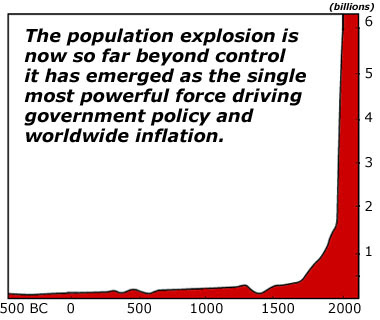
Population Explosion: The Most Powerful Force on EarthOnly since 1800, in the last 0.1% of the history of Homo sapiens, has the human population shot into the billions. Now at nearly 6.7 billion, with 9 billion looming 40 years away, few environmentalists seem to care.

Yet the population-environment link is clear. Our environmental impact, as gauged by total resource consumption for a country or the world, is the product of population size and the average person's consumption.

Today's crumbling environment, racked by climate change, mass extinction, deforestation, collapsing fisheries and more is evidence our total consumption has gone too far. We are destroying our life-support system. In ecological terms we are in "overshoot" of Earth's "carrying capacity" for humans, our demand exceeding the planet's absorptive and regenerative capacities.

To avert catastrophe, we need to reduce both factors in the equation: our numbers and per person consumption.

Thursday, May 14, 2009

National Security Study Memorandum 200: Implications of Worldwide Population Growth


[Д♠]START:: Pin.2.Gong RUMC.316.H4RO ::STOP[♠Д]  US Army War College: People Wars: Ruminations on Population and Security: “How does one say ‘Lebensraum’ in Chinese?”

If each human family were dependent only on its own resources; if the children of improvident parents starved to death; if thus, over breeding brought its own "punishment" to the germ line -- then there would be no public interest in controlling the breeding of families. But our society is deeply committed to the welfare state, and hence is confronted with another aspect of the tragedy of the commons.

In a welfare state, how shall we deal with the family, the religion, the race, or the class (or indeed any distinguishable and cohesive group) that adopts over breeding as a policy to secure its own aggrandizement? To couple the concept of freedom to breed with the belief that everyone born has an equal right to the commons is to lock the world into a tragic course of action.
~ Killing Times: The Killing Times are Here: Population Policy || Depopulation or Perish || Tragedy of the Commons ~

______________________________________________________________

National Security Study Memorandum 200:

Implications of Worldwide Population Growth for U.S. Security and Overseas Interests, April 1974

Center for Population & Security


20 KEY POINTS FROM THE MAIN BODY OF THE REPORT

All readers are urged to read the detailed main body of the report which is presented in full in Appendix Two. This will give the reader a better appreciation of the gravity of this new threat to U.S. and global security and the actions the many departments of our government felt were necessary in order to address this grave new threat -- a threat greater than nuclear war. These 20 important points will be discussed in the remaining chapters of this book.

On the magnitude and urgency of the problem:

  1. "... World population growth is widely recognized within the Government as a current danger of the highest magnitude calling for urgent measures." [Page 194]

  2. "... it is of the utmost urgency that governments now recognize the facts and implications of population growth, determine the ultimate population sizes that make sense for their countries and start vigorous programs at once to achieve their desired goals." [Page 15]

  3. "... population factors are indeed critical in, and often determinants of, violent conflict in developing areas. Segmental (religious, social, racial) differences, migration, rapid population growth, differential levels of knowledge and skills, rural/urban differences, population pressure and the spatial location of population in relation to resources -- in this rough order of importance -- all appear to be important contributions to conflict and violence... Clearly, conflicts which are regarded in primarily political terms often have demographic roots. Recognition of these relationships appears crucial to any understanding or prevention of such hostilities." [Page 66]

  4. "Where population size is greater than available resources, or is expanding more rapidly than the available resources, there is a tendency toward internal disorders and violence and, sometimes, disruptive international policies or violence." [Page 69]

  5. "In developing countries, the burden of population factors, added to others, will weaken unstable governments, often only marginally effective in good times, and open the way to extremist regimes." [Page 84]

  6. The report gives three examples of population wars: the El Salvador-Honduras "Soccer War" [Page 71]; the Nigerian Civil War [Page 71]; and, the Pakistan-India-Bangladesh War, 1970-71. [Page 72]

  7. "... population growth over the years will seriously negate reasonable prospects for the sound social and economic development of the peoples involved." [Page 98]

  8. "Past experience gives little assistance to predicting the course of these developments because the speed of today's population growth, migrations, and urbanization far exceeds anything the world has ever seen before. Moreover, the consequences of such population factors can no longer be evaded by moving to new hunting or grazing lands, by conquering new territory, by discovering or colonizing new continents, or by emigration in large numbers.

    The world has ample warning that we all must make more rapid efforts at social and economic development to avoid or mitigate these gloomy prospects. We should be warned also that we all must move as rapidly as possible toward stabilizing national and world population growth." [Page 85]


    Leadership is vital

  9. "Successful family planning requires strong local dedication and commitment that cannot over the long run be enforced from the outside." [Page 106]

  10. "... it is vital that leaders of major LDCs themselves take the lead in advancing family planning and population stabilization, not only within the UN and other international organizations but also through bilateral contacts with leaders of other LDCs." [Page 112]

  11. "These programs will have only modest success until there is much stronger and wider acceptance of their real importance by leadership groups. Such acceptance and support will be essential to assure that the population information, education and service programs have vital moral backing, administrative capacity, technical skills and government financing." [Page 195]


    What must be done:

  12. "Control of population growth and migration must be a part of any program for improvement of lasting value." [Page 81]

  13. "... the Conference adopted by acclamation (only the Holy See stating a general reservation) a complete World Population Plan of Action" [Page 87]

  14. "Our objective should be to assure that developing countries make family planning information, education and means available to all their peoples by 1980." [Page 130]

  15. "Only nominal attention is [currently] given to population education or sex education in schools..." [Page 158]

    "Recommendation: That US agencies stress the importance of education of the next generation of parents, starting in elementary schools, toward a two-child family ideal. That AID stimulate specific efforts to develop means of educating children of elementary school age to the ideal of the two-child family..." [Page 159]

  16. "...there is general agreement that up to the point when cost per acceptor rises rapidly, family planning expenditures are generally considered the best investment a country can make in its own future," [Page 53]


    Contradiction of the Holy See's answer to the population problem:

  17. "Clearly development per se is a powerful determinant of fertility. However, since it is unlikely that most LDCs will develop sufficiently during the next 25-30 years, it is crucial to identify those sectors that most directly and powerfully affect fertility." [Page 99]

  18. "There is also even less cause for optimism on the rapidity of socio-economic progress that would generate rapid fertility reduction in the poor LDCs, than on the feasibility of extending family planning services to those in their populations who may wish to take advantage of them." [Page 99]

  19. "But we can be certain of the desirable direction of change and can state as a plausible objective the target of achieving replacement fertility rates by the year 2000." [Page 99]


    Abortion is vital to the solution:

  20. "While the agencies participating in this study have no specific recommendations to propose on abortion, the following issues are believed important and should be considered in the context of a global population strategy...Certain facts about abortion need to be appreciated:

    " -- No country has reduced its population growth without resorting to abortion". [Page 182]

    " -- Indeed, abortion, legal and illegal, now has become the most widespread fertility control method in use in the world today." [Page 183]

    " -- It would be unwise to restrict abortion research for the following reasons: 1) The persistent and ubiquitous nature of abortion. 2) Widespread lack of safe abortion techniques..." [Page 185]


*************


National Security Study Memorandum 200:

Implications of Worldwide Population Growth for U.S. Security and Overseas Interests, April 1974

Center for Population & Security


TABLE OF CONTENTS

Cover letter | Cover page | Executive Summary


PART ONE. ANALYTICAL SECTION


PART TWO POLICY RECOMMENDATIONS


Sources: Center for Population & Security
Pres. Nixon's Cover Letter (PDF:2P) :: NSSM 200 (PDF:123P)


Saturday, April 18, 2009

High birth rates hamper development in poorer countries | UN: World Population over 9 Billion by 2050 | Sex is Main Cause of Pop. Growth


[SufiRRRVilnius  :: StratCentMuse :: BBB MonteChristo]The Center for Research on Population & Security, by Stephen Mumford, Ph.D. | CIA & Pentagon on Population & Resource Wars

Today, 6.5 billion humans depend entirely on oil for food, energy, plastics & chemicals. Population growth is on a collision course with the inevitable decline in oil production.

To think that we can advocate for human rights, peace, and social justice while ignoring their necessary ecological basis—is both intellectually dishonest and ultimately self-defeating.

The longer we put off choosing the nicer methods of achieving demographic stability, the more likely the nasty ones become, whether imposed by nature or by some fascistic regime. Urine Good Company might represent a mild version of what could actually be in store if we let the marketplace, corporations, and secretive, militaristic governments come up with eugenic solutions to our population dilemma.
~ Population, Resources, and Human Idealism, Energy Bulletin | Population Growth: Most Powerful Force on Earth, Money&Markets ~


High birth rates hamper development in poorer countries, warns UN forum

United Nations


1 April 2009 – Rapid population growth, fuelled by high fertility, presents a barrier to reducing poverty levels and reaching other internationally agreed development goals, experts attending the current session of the United Nations population body said today.

The meeting of the Commission on Population and Development, which began on Monday and concludes on Friday, is examining the extent to which population growth affects the achievement of the Millennium Development Goals (MDGs), globally agreed targets on reducing poverty and eliminating other social ills by 2015.

Although birth rates have been on the slide across the developing world since the 1970s, women in most of the least developed countries (LDCs) still have five children each on average, according to a policy brief presented by the Population Division of the UN Department of Economic and Social Affairs (DESA).

The lack of access to family planning and to modern methods of contraception is the major cause of this persistence in high fertility.

“When individuals and couples are given the possibility of deciding how many children they want to have, they usually opt for much lower numbers than they used to,” Hania Zlotnik, Director of the Population Division, told the press at UN Headquarters in New York at a briefing focusing on the work of the Commission.

Ms. Zlotnik noted that giving people the information and means for reaching their reproductive goals – without any kind of interference or coercion – has significant implications for economic and social development.

Reducing population growth through cutting fertility rates, versus increasing mortality or restricting migration, is beneficial to the economy, as low fertility increases the number of people of working age per capita as well as output per capita, according to the Population Division brief.

Benefits to economic growth also occur as lowering fertility leads to an increase in the supply of female labour, particularly in urban areas in developing countries.

In addition, smaller family size allows for greater investment in the health and education of children in the longer term both from the family and government.

Source: United Nations

______________________________________________________________

Revised UN estimates put world population at over 9 billion by 2050

United Nations


11 March 2009 – The world’s population will hit 7 billion early in 2012 and top 9 billion in 2050, with the majority of the increase taking place in developing countries, according to revised United Nations estimates released today.

“There have been no big changes for the recent estimates and we have not changed the assumptions for the future,” Hania Zlotnik, Director of the Population Division at the Department of Economic and Social Affairs (DESA), told reporters in New York.

“We’re still projecting that by 2050 the population of the world will be around 9.1 billion,” she said, as she presented the 2008 Revision of the World Population Prospects.

The Revision also says that nine countries are expected to account for half of the world’s projected increase from 2010 to 2050: India, Pakistan, Nigeria, Ethiopia, United States, the Democratic Republic of Congo (DRC), Tanzania, China and Bangladesh.

Ms. Zlotnik noted that current projections are based on the assumption that fertility is going to decline from the current global level of 2.5 children per woman to 2.1 children per woman from now until 2050.

The population of the 49 least developed countries (LDCs) is still the fastest growing in the world, at 2.3 per cent per year, according to a news release issued by the Population Division.

While the population of developing countries as a whole is projected to rise from 5.6 billion in 2009 to 7.9 billion in 2050, the population of more developed regions is expected to change minimally, passing from 1.23 billion to 1.28 billion.

The latter would have declined to 1.15 billion were it not for the projected net migration from developing to developed countries, which is expected to average 2.4 million persons annually from 2009 to 2050.

The UN adds that projected trends are contingent on fertility declines in developing countries. Without further reductions of fertility, the world population could increase by nearly twice as much as currently expected.

“It is going to be extremely important to continue funding and increasing the funding that has gone down for family planning because, if not, our projections on declining fertility are unlikely to be met,” Ms. Zlotnik stated.

She added that the projected population trends also depend on achieving a major increase in the proportion of AIDS patients who get anti-retroviral therapy to treat the disease and on the success of efforts to control the further spread of HIV.

Among the other findings, she noted that most developing countries are unlikely to meet the goal of reducing under-five mortality by two-thirds by 2015, one of eight globally agreed targets set out in the Millennium Development Goals (MDGs).

Source: United Nations

______________________________________________________________

Sex is main cause of population growth

Optimum Population Trust


March 26, 2009

Sex, not religious or cultural beliefs or the quest for economic security, is what increases family size and drives world population growth, according to one of the UK’s leading authorities on family planning.

Conventional economic wisdom, which says that couples in poorer societies actively plan to have large families to compensate for high child mortality, to provide labour, and to care for parents in their old age, is wrong, Professor John Guillebaud will tell a conference on sustainable population today (Thursday, March 26).

Economists overlook the fact that sexual intercourse is more frequent than the minimum needed for intentional conceptions, and that half of pregnancies worldwide are unplanned. Moreover, demand for contraception increases when it is available, irrespective of a society’s wealth or child survival rates.

“Having a large rather than a small family is less of a planned decision than an automatic outcome of human sexuality,” Prof. Guillebaud will say. “For a fertile couple, nothing is easier.”

Prof. Guillebaud, emeritus professor of family planning and reproductive health at University College, London, is one of a group of experts who will be discussing the scientific rationale for reducing population to environmentally sustainable levels at today’s conference, organised by the Optimum Population Trust.

Other speakers include: Tim Dyson, professor of demography at the London School of Economics; Prof. Andrew Watkinson, former director of the Tyndall Centre for Climate Change Research; Robin Maynard, campaigns director of the Soil Association; Prof. Chris Rapley, director of the Science Museum; Jonathon Porritt, chair of the Sustainable Development Commission; Sara Parkin, founder-director of Forum for the Future and former co-chair of the Green Party; and Dr. Martin Desvaux, an ecological footprint specialist.

Many environmentalists argue that greener lifestyles, and reducing consumption, are the key to solving environmental challenges such as climate change. However, Dr. Desvaux will disclose details of research showing that even with an 80 per cent reduction in carbon emissions by 2050, the UK will be able to sustain only 37 million people; a “zero-carbon” economy will support only 52 million people in 2050. This will make the UK “extremely vulnerable in an uncertain world”, he will argue. The UK’s population, currently 61 million, is projected to rise to 77 million by 2050.

Even if Britain’s population could be capped at 70 million, as suggested by the immigration minister, Phil Woolas, last year, there would still be up to 33 million too many people in the UK for long-term sustainability, according to Dr. Desvaux.

The conference will also hear that:

*The UK could face major problems because of its high population density and low agricultural self-sufficiency. To reduce London’s current “food footprint” of some 20 million hectares - 2 million more than the UK’s agricultural land area – to a globally sustainable “fair share”, Londoners would need to eat an estimated 70 per cent less meat.

*Despite the likelihood of a world population crash as a consequence of inaction on overpopulation, 21 European countries are trying to raise their birth rates.

Prof. Guillebaud will argue that in both rich and poor countries, “something active needs to be done to separate sex from conception - namely, contraception…The evidence is clear within a wide variety of settings that - despite no prior increase in per capita wealth or child survival or other presumed essentials - demand for contraception increases when it becomes available, accessible, and accompanied by correct information about its appropriateness and safety.”

Yet despite being long seen as synonymous with contraception, the oral contraceptive pill is not an ideal method. It has the wrong “default state” - conception occurs if an error is made in its use. Long-acting reversible contraceptives, such as implants or copper intrauterine devices (IUDs), are far more effective because, unlike the pill, they are “forgettable”: mistakes in use do not result in conception.

Prof. Guillebaud argues that LARCs are particularly valuable for young people, “whose track record for unwanted conceptions - due to failure to comply properly with pill-taking even where oral contraception is available - is high in all societies”. This is a crucial feature in reducing population growth, he adds, since nearly half the world’s population is under the age of 25.

The conference, Environmentally Sustainable Populations: The scientific case for population policy - and ways of achieving sustainability, is being held at the Royal Statistical Society.

NOTES

A synopsis of Prof. Guillebaud’s paper is appended to this release.
The UN estimates that over 200 million women worldwide lack access to effective contraception.

FOR FURTHER INFORMATION:

Contact Prof. John Guillebaud on 07779 180188 or telephone 07976 370221

For information about the conference, contact Julie Lewis, administrator, Optimum Population Trust, 07531 316564, admin@optimumpopulation.org

NOTES FOR EDITORS: The OPT, a think-tank and campaign group, was founded in 1991 by the late David Willey. Its main aims are to promote and co-ordinate research into criteria that will allow the sustainable or optimum population of a region to be determined. Its patrons include Sir Partha Dasgupta, Frank Ramsey professor of economics at Cambridge University; Paul Ehrlich, professor of population studies, Stanford University; Jane Goodall, founder, the Jane Goodall Institute, UN Messenger of Peace; John Guillebaud, emeritus professor of family planning and reproductive health, University College, London; Susan Hampshire, actor; Aubrey Manning, broadcaster and professor of natural history, Edinburgh University; Professor Norman Myers, visiting fellow, Green College, Oxford; Sara Parkin, founder director and trustee, Forum for the Future; Sir Jonathon Porritt, chairman of the UK Sustainable Development Commission; and Sir Crispin Tickell, director of the Policy Foresight Programme, James Martin Institute for Science and Civilisation, Oxford University

Scientific Solutions in Contraception

John Guillebaud, emeritus professor of family planning and reproductive health, University College, London

Paper for: Environmentally Sustainable Populations: The scientific case for population policy - and ways of achieving sustainability, Optimum Population Trust conference, Royal Statistical Society, March 26, 2009.

It is often assumed that any quantitative concern for population must be intrinsically coercive. But why consider infringing human rights when around half of pregnancies worldwide are unplanned? Moreover, numerous countries as varied as Costa Rica, Iran, Korea, Sri Lanka, and Thailand halved their total fertility rates primarily through meeting women’s unmet fertility needs and choices. What features do such disparate “success story” countries have in common - and how might they be replicated?

Conventional economic wisdom says that couples in resource poor settings actively plan to have many children to compensate for high child mortality, to provide labour, and to care for parents as they age. Often with cultural and religious endorsement, those factors clearly enhance the post hoc acceptance of large families. But economists overlook the fact that, everywhere, potentially fertile intercourse is more frequent than the minimum needed for intentional conceptions.

Thus, having a large rather than a small family is less of a planned decision than an automatic outcome of human sexuality. For a fertile couple, nothing is easier. Whether in resource poor or rich settings, something active needs to be done to separate sex from conception—namely, contraception. Moreover access to contraception is often difficult. Barriers to women’s choice are created through lack of empowerment and abuse of their rights by husbands or other family members; or religious authorities and some governments (for example, the Philippines) and, regrettably, sometimes even contraceptive providers. Misinformation abounds: in Rwanda, for instance, rumours have spread that hormonal contraceptives cause permanent sterility and that condoms always have holes in them.

The evidence is clear within a wide variety of settings that—despite no prior increase in per capita wealth or child survival or other presumed essentials—demand for contraception increases when it becomes available, accessible, and accompanied by correct information about its appropriateness and safety; when barriers are removed; and when there is good publicity and marketing principles are applied. This is consistent with normal consumer behaviour.

In Iran, where the total fertility rate (”average family size”) declined from 5.5 to 2 (replacement level) in just 15 years, all couples must learn about family planning before marriage and contraception was endorsed by the edicts of religious leaders. The Population Media Centre uses serial radio dramas or “soaps”. Audiences learn from decisions that their favourite characters make—such as allowing wives to use contraception to achieve smaller and healthier families. In Rwanda, 57% of new attendees at family planning clinics named the radio drama “Rwanda’s Brighter Future” as their reason for attending.

Contraceptive technology – which methods are best?
For too long the very name ‘pill’ has been seen as synonymous with contraception. Yet the combined oral contraceptive pill is not an ideal method. It has the wrong “default state”, namely conception if an error is made in its use. And user-failure errors are very common, so that its failure rate in typical use is up to 10 times higher than its theoretical effectiveness.

A better model for most of us humans would be a long-acting yet fully reversible contraceptive: having the right “default state”, namely of contraception - regardless of what the user does or doesn’t do. Such a method – invariably some kind of insert or implant - requires a single decision when sexual activity starts, to “opt out” of fertility. (Note that in principle the method could be for use by either sex). After that, the user becomes free of all contraceptive responsibility. In a future utopian version there would be no side effects, nothing else to be done until the individual was ready to “opt in” to restored fertility. At that point a second voluntary action would reverse the method. Until then, the method would have that crucial virtue among contraceptives of total “forgettability”.

Over the past 100 years scientific research has already produced several such long-acting reversible contraceptives (LARCs): they are the copper intrauterine devices (IUDs) and an intrauterine system (IUS); injectables; and subcutaneous implants. While not achieving the contraceptive utopia just described, because of side effects - principally irregular bleeding - they do have that ideal default state. They have been established to have, in typical use, much higher continuation rates and effectiveness than pills - indeed the same effectiveness as female sterilization. But in settings where there is high infant mortality they are far more appropriate than sterilization, which is essentially irreversible and for too long has been the mainstay of many developing world programmes. Moreover, these LARCs are particularly valuable for young people, whose track record for unwanted conceptions –due to failure to comply properly with pill-taking even where oral contraception is available - is high in all societies. Given that close to half of the world’s population is under age 25, we can therefore add another crucial feature to those above that are shared by the successful countries: that they have offered to the majority of their citizens a good range of choice of contraceptives, including most or all of these long-acting methods.

Source: Optimum Population Trust

Thursday, April 2, 2009

Depopulation of a Planet (1/6): Thinning Out The "Useless Eaters": An Unspoken NWO Agenda


[RRR Zhivago Hunter :: Hell Hath No Fury Commons :: Buffalo Bill DMW] “Nuclear Freedom is the Recognition of Mutual Coercion, Mutually Agreed Upon Procreation Values Necessity”

Today, 6.5 billion humans depend entirely on oil for food, energy, plastics & chemicals. Population growth is on a collision course with the inevitable decline in oil production.

To think that we can advocate for human rights, peace, and social justice while ignoring their necessary ecological basis—is both intellectually dishonest and ultimately self-defeating.

The longer we put off choosing the nicer methods of achieving demographic stability, the more likely the nasty ones become, whether imposed by nature or by some fascistic regime. Urine Good Company might represent a mild version of what could actually be in store if we let the marketplace, corporations, and secretive, militaristic governments come up with eugenic solutions to our population dilemma.
~ Population, Resources, and Human Idealism, Energy Bulletin | Population Growth: Most Powerful Force on Earth, Money&Markets ~

______________________________________________________________

Depopulation of a Planet

Thinning Out The "Useless Eaters"

An Unspoken NWO Agenda

Part I: Historical Perspective
Part II: What you can’t see will hurt you!
Part III: No easy Answers!
Part IV: A Picture Emerges
Part V: U.N. Rings the Alarm
Part VI: The Final Chapter


A Report by RICK MARTIN

Part I: Historical Perspective


11/19/95

Many writers have spoken of intentional plans by certain Elite to thin-out the world's population; it's a recurring theme among so-called conspiracy theorists. There are frequent references to "useless eaters", which includes the bulk of mankind. Most, when hearing of plots to depopulate the planet, simply say under their breath, "Yeah, right," or more often, while shaking their head, "You're nuts." But when there is a careful examination of writings by prominent authors of this century, pieces of the puzzle certainly do fall into place - pieces which support the contention that there are certain individuals, if not entire governments, who have implemented a program of global genocide in an effort to salvage and corner "resources".

What you will be reading in this series on Depopulation Of A Planet are selected writings from a wide cross-section of viewpoints and political leanings. I will be using "their" own documents, their own words, to weave a fabric which, in the end, will be a tapestry of undeniable clarity for those with eyes to see.

Without the historical foundation upon which to base understanding, writing about current efforts at depopulation, through the use of viruses and microorganisms, would have far less significance. So please stay with it as you read and it will come together. I realize that some of this initial material may seem dry, but it is important for a broader understanding of this critical and timely issue.


THOMAS MALTHUS


Thomas Robert Malthus was a parson of the English State Church and an economist who lived from 1766-1834. He is best known for his writing An Essay On The Principle Of Population, published in 1798. His main idea is that populations increase more rapidly than food supplies. So, he claimed, there would always be more people in the world than can be fed, and wars and disease will be necessary to kill off the extra population.

Malthus did not claim to be the originator of this idea, although it has come to be known as the "Malthusian Theory". Malthus based his argument on the works of Condorcet, David Hume, Adam Smith, Defoe, Sir James Steuart, Townsend, Franklin, and others.

Malthus' Essay suggested to Charles Darwin the relationship between progress and the survival of the fittest. This was the basic idea in Darwin's theory of evolution.


GEORG WILHELM HEGEL


Turning to the New American Encyclopedia, we read, "Georg Wilhelm Friedrich Hegel (1770-1831), German philosopher of idealism who had an immense influence on 19th and 20th-century thought and history. During his life he was famous for his professorial lectures at the University of Berlin and he wrote on logic, ethics, history, religion and aesthetics. The main feature of Hegel's philosophy was the dialectical method by which an idea (thesis) was challenged by its opposite (antithesis) and the two ultimately reconciled in a third idea (synthesis) which subsumed both. Hegel found this method both in the workings of the mind, as a logical procedure, and in the workings of the history of the world, which to Hegel was the process of the development and realization of the World Spirit (Weltgeist). Hegel’s chief works were Phenomenology of the Mind (1807) and Philosophy Of Right (1821). His most important follower was Marx."

In the book edited by Carl J. Friedrich entitled The Philosophy of Hegel, Hegel writes in The Philosophy of History, "In the Christian religion God has revealed Himself, giving to men the knowledge of what He is so that He is no longer secluded and secret. With this possibility of knowing Him, God has imposed upon us the duty to so know Him. The development of the thinking spirit, which has started from this basis, from the revelation of the Divine Being, must at last progress to the point where what was at first presented to the spirit in feeling and imagination is comprehended by thought. Whether the time has come to achieve this knowledge depends upon whether the final end of the world has at last entered into actual reality in a generally valid and conscious manner."

Hegel concludes with, "World history, with all the changing drama of its histories, is this process of the development and realization of the spirit. It is the true theodicy, the justification of God in history. Only this insight can reconcile the spirit with world history and the actual reality, that what has happened, and is happening every day, is not only not 'without God', but is essentially the work of God."

In his work A History Of Western Philosophy, Bertrand Russell writes, "Throughout the whole period after the death of Hegel, most academic philosophy remained traditional, and therefore not very important. British empiricist philosophy was dominant in England until near the end of the century, and in France until a somewhat earlier time; then, gradually, Kant and Hegel conquered the universities of France and England, so far as their teachers of technical philosophy were concerned."

Russell continues, "[Condorcet 1743-1794]...was also the inventor of Malthus's theory of population, which, however, had not for him the gloomy consequences that it had for Malthus, because he coupled it with the necessity of birth control. Malthus's father was a disciple of Condorcet, and it was in this way that Malthus came to know of the theory."

Of Hegel, Russell writes in part, "Hegel does not mean only that, in some situations, a nation cannot rightly avoid going to war. He means much more than this. He is opposed to the creation of institutions - such as a world government - which would prevent such situations from arising, because he thinks it is a good thing that there should be wars from time to time. War, he [Hegel] says is the condition in which we take seriously the vanity of temporal goods and things. (This view is to be contrasted with the opposite theory, that all wars have economic causes.) War has a positive moral value: 'War has the higher significance that through it the moral health of peoples is preserved in their indifference towards the stabilizing of finite determinations.'"

Still quoting Bertrand Russell, "The Philosophical Radicals were a transitional school. Their system gave birth to two others, of more importance than itself, namely Darwinism and Socialism. Darwinism was an application to the whole of animal and vegetable life of Malthus's theory of population, which was an integral part of the politics and economics of the Benthamites - a global free competition, in which victory went to the animals that most resembled successful capitalists. Darwin himself was influenced by Malthus, and was in general sympathy with the Philosophical Radicals. There was, however, a great difference between the competition admired by orthodox economists and the struggle for existence which Darwin proclaimed as the motive force of evolution. 'Free competition,' in orthodox economics, is a very artificial conception, hedged in by legal restrictions. You may undersell a competitor, but you must not murder him. You must not use the armed forces of the State to help you to get the better of foreign manufacturers. Those who have not the good fortune to possess capital must not seek to improve their lot by revolution. 'Free competition,' as understood by the Benthamites, was by no means really free.

"Darwinian competition was not of this limited sort; there were no rules against hitting below the belt. The framework of law does not exist among animals, nor is war excluded as a competitive method. The use of the State to secure victory in competition was against the rules as conceived by the Benthamites, but could not be excluded from the Darwinian struggle. In fact, though Darwin himself was a liberal, and though Nietzsche never mentioned him except with contempt, Darwin's Survival Of The Fittest led, when thoroughly assimilated, to something much more like Nietzsche's philosophy than like Bentham's. These developments, however, belong to a later period, since Darwin's Origin Of Species was published in 1859, and its political implications were not at first perceived."


KARL MARX


In his 1843 writing from The Kreuznach Manuscripts: Critique Of Hegel's Philosophy Of Right [from Discussion Of The Princely Power, Comments On Hegel's 279] Karl Marx writes,

"Democracy is the truth of monarchy; monarchy is not the truth of democracy. Monarchy is forced to be democracy as a non sequitur within itself, whereas the monarchical moment is not a non sequitur within democracy. Democracy can be understood in its own terms; monarchy cannot. In democracy, none of its moments acquires a meaning other than that which is appropriate to it. Each is actually only a moment within the whole demos. In monarchy, a part determines the character of the whole. The whole constitution has to take shape of this firm foundation. Democracy is the type or species of the constitution. Monarchy is a variety, and indeed a bad variety. Democracy is 'form and content'. Monarchy is supposed to be only form, but it falsifies the content.

"In monarchy, the whole, the people, is subsumed under one of its particular modes of existence, that of the political constitution. In democracy, on the other hand, the constitution itself appears as only one determination, and indeed, as the self-determination of the people. In monarchy, we have the people of the constitution; in democracy we have the constitution of the people. Democracy is the riddle of all constitutions solved. In democracy the constitution is always based on its actual foundation, on actual man and the actual people, not only in itself, according to its essence, but in its existence and actuality; it is postulated as autonomous. The constitution is seen as what it is, the freely-created product of man. One could say that in some respects this is also true of constitutional monarchy, but what specifically differentiates democracy is the fact that in democracy the constitution is only one particular moment in the existence of the people, that the political constitution does not itself constitute the state.

"Hegel begins with the state and turns man into the state subjectivized; democracy begins with man and makes the state into man objectivized. Just as religion does not create man but man creates religion, so the constitution does not create the people but the people create the constitution. In certain respects, democracy bears the same relation to all other forms of state as Christianity bears to all other religions. Christianity is religion par excellence, the essence of religion, man deified as a particular religion. Similarly, democracy is the essence of every constitution; it is socialized man as a particular constitution. Democracy is related to other constitutions as a species is related to its varieties. But in democracy the species itself appears as a particular [form of] existence, as one therefore that appears as a particular type vis-a-vis other particular [individual] existences that do not correspond to their essence. Democracy is the Old Testament in relation to all other forms of state. Man does not exist for the law, but the law exists for man. In democracy law is the existence of man, while in other forms of state man is the existence of law. This is the fundamental distinguishing mark of democracy."

Marx concludes with, "In all states other than democracy the state, the law, the constitution is dominant without actually dominating, i.e., without penetrating materially the content of the remaining non-political spheres: in democracy the constitution, the law, the state itself as a political constitution is only a self-determination of the people, a particular content of theirs.

"It is self-evident, incidentally, that all forms of state have democracy as their truth, and are therefore untrue in so far as they are not democratic."


In a correspondence of 1843, which was an exchange of letters between Marx, Ruge, and Bakunin concerning the prospects of social and political emancipation, Marx writes,

"Man's self-esteem, freedom, must be awakened once more in the heart of these men. Only this feeling, which disappeared from the world with the Greeks and vanished into the blue mists of heaven with Christianity, can once more transform society into a fellowship of men working for their highest purposes, a democratic state.

"Those people, on the other hand, who do not feel themselves to be men become appendages of their masters, like a herd of slaves or horses. The hereditary masters are the point of this whole society. This world belongs to them. They take it as it is and as it feels. They take themselves as they find themselves and stand where their feet have grown, on the necks of these political animals who know no other destiny than to be subject, loyal and at their master's service.

"The world of the Philistines is the political kingdom of animals; if we have to recognize its existence then we have no alternative but simply to accept the status quo. Centuries of barbarism created and shaped it and it now exists as a consistent system, whose principle is the dehumanized world. The perfected world of the Philistine, our Germany, naturally had to lag far behind the French Revolution, which restored man to himself. A German Aristotle, who would take his Politics from our conditions, would write on the first page: 'Man is a social, but a completely apolitical, animal’."


Further on, Marx continues,
"To be sure, in times when the political state as such is born, violently, out of civil society, when men strive to liberate themselves under the form of political self-liberation, the state can and must go on to abolish and destroy religion. But it does so only the way that it abolishes private property, by setting a maximum, providing for confiscation and progressive taxation, just as it abolished life by establishing the guillotine. In moments when political life has a specially strong feeling for its own importance, it seeks to repress its presuppositions, civil society and its elements, and to constitute itself as the real, harmonious species-life of man. It can do this only by entering into violent contradiction with its own conditions of existence; it can do so only by declaring the revolution to be permanent; and the political drama therefore necessarily ends with the restoration of religion, of private property, and of all the elements of civil society, just as war ends with peace...

"We have shown, then, that political emancipation from religion leaves religion standing, even if not as privileged religion. The contradiction in which the follower of a specific religion finds himself in relation to his citizenship is only one aspect of the universal secular contradiction between the political state and civil society. The consummation of the Christian state is a state that recognizes itself as state and abstracts itself from the religion of its members. The emancipation of the state from religion is not the emancipation of actual man from religion."


In Capital, Marx writes,

The laboring population therefore produces, along with the accumulation of capital produced by it, the means by which itself is made relatively superfluous, is turned into a relative surplus-population; and it does this to an always increasing extent. This is the law of population peculiar to the capitalist mode of production; and in fact every specific historic mode of production has its own specific laws of population, historically valid within its limits alone. An abstract law of population exists for plants and animals only, and only insofar as man has not interfered with them.


Bertrand Russell writes in A History Of Western Philosophy,

"Marx's philosophy of history is a blend of Hegel and British economics. Like Hegel, he thinks that the world develops according to a dialectical formula, but he totally disagrees with Hegel as to the motive force of this development. Hegel believed in a mystical entity called Spirit, which causes human history to develop according to the stages of the dialectic as set forth in Hegel's Logic. Why Spirit has to go through these stages is not clear. One is tempted to suppose that Spirit is trying to understand Hegel, and at each stage rashly objectifies what it has been reading. Marx's dialectic has none of this quality except a certain inevitableness. For Marx, matter, not spirit, is the driving force. But it is a matter in the peculiar sense that we have been considering, not the wholly dehumanized matter of the atomists. This means that, for Marx, the driving force is really man's relation to matter, of which the most important part is his mode of production. In this way Marx's materialism, in practice, becomes economics."


THE FABIAN SOCIETY


In one of his Fabian Essays [The Fabian Society], entitled Economic, George Bernard Shaw wrote the following in 1889,

"All economic analyses begin with the cultivation of the Earth. To the mind's eye of the astronomer the Earth is a ball spinning in space without ulterior motives. To the bodily eye of the primitive cultivator it is a vast green plain, from which, by sticking a spade into it, wheat and other edible matters can be made to spring." Shaw continues, "It was the increase of population that spread cultivation and civilization from the center to the snow line, and at last forced men to sell themselves to the lords of the soil: it is the same force that continues to multiply men so that their exchange value fails slowly and surely until it disappears altogether - until even black chattel slaves are released as not worth keeping in a land where men of all colors are to be had for nothing. This is the condition of our English laborers today: they are no longer even dirt cheap; they are valueless, and can be had for nothing."


On overpopulation Shaw writes,

"The introduction of the capitalistic system is a sign that the exploitation of the laborer toiling for a bare subsistence wage has become one of the chief arts of life among the holders of tenant rights. It also produces a delusive promise of endless employment which blinds the proletariat to those disastrous consequences of rapid multiplication which are obvious to the small cultivator and peasant proprietor. But indeed the more you degrade the workers, robbing them of all artistic enjoyment, and all chance of respect and admiration from their fellows, the more you throw them back, reckless, on the one pleasure and the one human tie left to them - the gratification of their instinct for producing fresh supplies of men. You will applaud this instinct as divine until at last the excessive supply becomes a nuisance: there comes a plague of men; and you suddenly discover that the instinct is diabolic, and set up a cry of 'overpopulation'. But your slaves are beyond caring for your cries: they breed like rabbits; and their poverty breeds filth, ugliness, dishonesty, disease, obscenity, drunkenness, and murder. In the midst of the riches which their labour piles up for you, their misery rises up too and stifles you. You withdraw in disgust to the other end of the town from them; you appoint special carriages on your railways and special seats in your churches and theaters for them; you set your life apart from theirs by every class barrier you can devise; and yet they swarm about you still: your face gets stamped with your habitual loathing and suspicion of them: your ears get so filled with the language of the vilest of them that you break into it when you lose your self-control: they poison your life as remorselessly as you have sacrificed theirs heartlessly. You begin to believe intensely in the devil. Then comes the terror of their revolting; the drilling and arming of bodies of them to keep down the rest; the prison, the hospital, paroxysms of frantic coercion, followed by paroxysms of frantic charity. And in the meantime, the population continues to increase!"


GEORGE ORWELL


In George Orwell's classic Animal Farm, he writes,

"Now, comrades, what is the nature of this life of ours? Let us face it: our lives are miserable, laborious, and short. We are born, we are given just so much food as will keep the breath in our bodies, and those of us who are capable of it are forced to work to the last atom of our strength; and the very instant that our usefulness has come to an end we are slaughtered with hideous cruelty. No animal in England knows the meaning of happiness or leisure after he is a year old. No animal in England is free. The life of an animal is misery and slavery: that is the plain truth.

"But is this simply part of the order of nature? Is it because this land of ours is so poor that it cannot afford a decent life to those who dwell upon it? No, comrades, a thousand times no! The soil of England is fertile, its climate is good, it is capable of affording food in abundance to an enormously greater number of animals than now inhabit it. This single farm of ours would support a dozen horses, twenty cows, hundreds of sheep - and all of them living in a comfort and a dignity that are now almost beyond our imagining. Why then do we continue in this miserable condition? Nearly the whole of the produce of our labour is stolen from us by human beings. There, comrades, is the answer to all our problems. It is summed up in a single word - Man. Man is the only real enemy we have. Remove Man from the scene, and the root cause of hunger and overwork is abolished for ever.

"Man is the only creature that consumes without producing. He does not give milk, he does not lay eggs, he is too weak to pull the plough, he cannot run fast enough to catch rabbits. Yet he is lord of all the animals. He sets them to work, he gives back to them the bare minimum that will prevent them from starving, and the rest he keeps for himself. Our labour tills the soil, our dung fertilizes it, and yet there is not one of us that owns more than his bare skin. You cows that I see before me, how many thousands of gallons of milk have you given during this last year? And what has happened to that milk which should have been breeding up sturdy calves? Every drop of it has gone down the throats of our enemies. And you hens, how many eggs have you laid in this last year, and how many of those eggs ever hatched into chickens? The rest have all gone to market to bring in money for Jones and his men. And you, Clover, where are those four foals you bore, who should have been the support and pleasure of your old age? Each was sold at a year old - you will never see one of them again. In return for your four confinements and all your labour in the fields, what have you ever had except your bare rations and a stall?

"And even the miserable lives we lead are not allowed to reach their natural span. For myself I do not grumble, for I am one of the lucky ones. I am twelve years old and have had over four hundred children. Such is the natural life of a pig. But no animal escapes the cruel knife in the end. You young porkers who are sitting in front of me, every one of you will scream your lives out at the block within a year. To that horror we all must come - cows, pigs, hens, sheep, everyone. Even the horses and the dogs have no better fate. You, Boxer, the very day that those great muscles of yours lose their power, Jones will sell you to the knacker, who will cut your throat and boil you down for the foxhounds. As for the dogs, when they grow old and toothless, Jones ties a brick around their neck and drowns them in the nearest pond.

"Is it not crystal clear, then, comrades, that all the evils of this life of ours spring from the tyranny of human beings? Only get rid of Man, and the produce of our labour would be our own. Almost overnight we could become rich and free. What then must we do? Why, work night and day, body and soul, for the overthrow of the human race. That is my message to you, comrades: Rebellion! I do not know when that Rebellion will come, it might be in a week or in a hundred years, but I know, as surely as I see this straw beneath my feet, that sooner or later justice will be done. Fix your eyes on that, comrades, throughout the short remainder of your lives! And above all, pass on this message of mine to those who come after you, so that future generations shall carry on the struggle until it is victorious.

"And remember, comrades, your resolution must never falter. No argument must lead you astray. Never listen when they tell you that Man and the animals have a common interest, that the prosperity of the one is the prosperity of the others. It is all lies. Man serves the interests of no creature except himself. And among us animals let there be perfect unity, perfect comradeship in the struggle. All men are enemies. All animals are comrades."


ALDOUS HUXLEY


In the Foreword to the 1946 (second printing) of the classic novel Brave New World, first published in 1932, author Aldous Huxley writes,

"There is, of course, no reason why the new totalitarians should resemble the old. Government by clubs and firing squads, by artificial famine, mass imprisonment and mass deportation, is not merely inhumane (nobody cares much about that nowadays); it is demonstrably inefficient and in an age of advanced technology, inefficiency is the sin against the Holy Ghost. A really efficient totalitarian state would be one in which the all-powerful executive of political bosses and their army of managers control a population of slaves who do not have to be coerced, because they love their servitude. To make them love it is the task assigned, in present-day totalitarian states, to ministries of propaganda, newspaper editors and school teachers. But their methods are still crude and unscientific. The old Jesuits' boast that, if they were given the schooling of the child, they could answer for the man's religious opinions, was a product of wishful thinking. And the modern pedagogue is probably rather less efficient at conditioning his pupils' reflexes than were the reverend fathers who educated Voltaire. The greatest triumphs of propaganda have been accomplished, not by doing something, but by refraining from doing. Great is truth, but still greater, from a practical point of view, is silence about truth. By simply not mentioning certain subjects, by lowering what Mr. Churchill calls an "iron curtain" between the masses and such facts or arguments as the local political bosses regard as undesirable, totalitarian propagandists have influenced opinion much more effectively than they could have done by the most eloquent denunciations, the most compelling of logical rebuttals. But silence is not enough. If persecution, liquidation and the other symptoms of social friction are to be avoided, the positive sides of propaganda must be made as effective as the negative. The most important Manhattan Projects of the future will be vast government-sponsored enquiries into what the politicians and the participating scientists will call "the problem of happiness" - in other words, the problem of making people love their servitude. Without economic security, the love of servitude cannot possibly come into existence; for the sake of brevity, I assume that the all-powerful executive and its managers will succeed in solving the problem of permanent security. But security tends very quickly to be taken for granted. Its achievement is merely a superficial, external revolution. The love of servitude cannot be established except as the result of a deep, personal revolution in human minds and bodies. To bring about that revolution we require, among others, the following discoveries and inventions. First, a greatly improved technique of suggestion - through infant conditioning and, later, with the aid of drugs, such as scopolamine. Second, a fully developed science of human differences, enabling government managers to assign any given individual to his or her proper place in the social and economic hierarchy. (Round pegs in square holes tend to have dangerous thoughts about the social system and to infect others with their discontents.) Third (since reality, however utopian, is something from which people feel the need of taking pretty frequent holidays), a substitute for alcohol and the other narcotics, something at once less harmful and more pleasure-giving than gin or heroin. And fourth (but this would be a long-term project, which it would take generations of totalitarian control to bring to a successful conclusion) a foolproof system of eugenics, designed to standardize the human product and so to facilitate the task of the managers. In Brave New World this standardization of the human product has been pushed to fantastic, though not perhaps impossible, extremes. Technically and ideologically we are still a long way from bottled babies and Bokanovsky groups of semi-morons. But by A.F. 600, who knows what may not be happening? Meanwhile the other characteristic features of that happier and more stable world - the equivalents of soma and hypnopaedia and the scientific caste system - are probably not more than three or four generations away. Nor does the sexual promiscuity of Brave New World seem so very distant. [Let me remind you this was written in 1946.] There are already certain American cities in which the number of divorces is equal to the number of marriages. In a few years, no doubt, marriage licenses will be sold like dog licenses, good for a period of twelve months, with no law against changing dogs or keeping more than one animal at a time. As political and economic freedom diminishes, sexual freedom tends compensatingly to increase. And the dictator (unless he needs cannon fodder and families with which to colonize empty or conquered territories) will do well to encourage that freedom. In conjunction with the freedom to daydream under the influence of dope and movies and the radio, it will help to reconcile his subjects to the servitude which is their fate.

"All things considered it looks as though Utopia were far closer to us than anyone, only fifteen years ago, could have imagined. Then, I projected it six hundred years into the future. Today it seems quite possible that the horror may be upon us within a single century. That is, if we refrain from blowing ourselves to smithereens in the interval. Indeed, unless we choose to decentralize and to use applied science, not as the end to which human beings are to be made the means, but as the means to producing a race of free individuals, we have only two alternatives to choose from: either a number of national, militarized totalitarianisms, having as their root the terror of the atomic bomb and as their consequence the destruction of civilization (or, if the warfare is limited, the perpetuation of militarism); or else one supra-national totalitarianism, called into existence by the social chaos resulting from rapid technological progress in general and the atomic revolution in particular, and developing, under the need for efficiency and stability, into the welfare-tyranny of Utopia. You pays your money and you takes your choice."


Mark Twain in The Mysterious Stranger writes,
"And what does it amount to?" said Satan, with his evil chuckle. "Nothing at all. You gain nothing: you always come out where you went in. For a million years the race has gone on monotonously propagating itself and monotonously re-performing this dull nonsense to what end? No wisdom can guess! Who gets a profit out of it? Nobody but a parcel of usurping little monarchs and nobilities who despise you; would feel defiled if you touched them; would shut the door in your face if you proposed to call; whom you slave for, fight for, die for, and are not ashamed of it, but proud; whose existence is a perpetual insult to you and you are afraid to resent it; who are mendicants supported by your alms, yet assume toward you the airs of benefactor toward beggar; who address you in the language of master toward slave, and are answered in the language of slave toward master; who are worshipped by you with your mouth, while in your heart if you have one you despise yourselves for it. The First man was a hypocrite and a coward, qualities which have not failed yet in his line; it is the foundation upon which all civilizations have been built."


In a lecture titled The Population Explosion, delivered at Santa Barbara, California. in 1959, Aldous Huxley said,

"Today I want to pass on to what is happening to the human species and to think a little about what our philosophy and our ethical outlook on the subject should be. This lecture is essentially about human numbers and their relation to human well-being and human values in general.

"Needless to say, any accurate estimation of human numbers is very recent, but we can extrapolate into the past and come to what seem to be fairly good conclusions. Although there are some fairly wide margins of difference among the experts, the numbers they come to are roughly in agreement. They agree that in pre-agricultural days, for example in the lower Palaeolithic times, when man was a food-gathering creature, there were probably not more than twenty million humans on this whole planet. In later Palaeolithic times, after organized hunting had been invented, the number probably doubled. We can make a rough estimate of what an organized hunting people could do because we know how many Indians were present in North America when the white man arrived - not more than one million in the entire North American continent east of the Rockies - and this gives one an indication of the extremely low density of population possible in a hunting economy.

"The Great Revolution came about 6000 B.C. with the invention of agriculture, and the creation of cities in the next millennia. By about 1000 B.C., after five thousand years of agriculture, there were probably about one hundred million people in the world.

"By the beginning of the Christian era, this figure had a little more than doubled: it was somewhere between two hundred million and two hundred and fifty million - less than half the present population of China. The population increased very gradually in the following years; sometimes there were long periods of standstill and sometimes there were even periods of decrease, as in the years immediately following 1348, when the Black Death killed off 30 percent of the population of Europe and nobody knows how much of the population of Asia.

"By the time the Pilgrim fathers arrived in this country, it is estimated that the population of the world was about twice what it had been on the first Christmas Day - that is to say, it had doubled in sixteen hundred years, an extremely slow rate of increase. But from that time on, from the middle of the seventeenth century, with the beginnings of the industrial revolution and the first importation of food from the newly developed lands of the New World, population began rising far more rapidly than it had ever risen before.

"By the time the Declaration of Independence was signed, the figure for the human population of the world was probably around seven hundred million; it must have passed the billion mark fairly early in the nineteenth century and stood at about fourteen hundred million around the time when I was born in the 1890s. The striking fact is that since that time the population of the planet has doubled again. It has gone from fourteen hundred million, which is already twice what it was at the signing of the Declaration of Independence, to twenty-eight hundred million. And the rate of increase now is such that it will probably double again in rather less than fifty years.

"Thus the rates of increase have been increasing along with the absolute increase in numbers."


[Please remember, this was written in 1959. The world's current population is rapidly approaching the 7 Billion figure - those are not "official" numbers, however.]……… [and 8 billion now in the year 2000 - update]

Still quoting Huxley:

"Let us now ask ourselves what the practical alternatives are as we confront this problem of population growth. One alternative is to do nothing in particular about it and just let things go on as they are, but the consequences of that course are quite clear: the problem will be solved by nature in the way that nature always solves problems of over-population - when any animal population tends (a) to starve and (b) to suffer from severe epidemic and epizootic diseases.

"In the human population, we can envisage that the natural check on the unlimited growth of population will be precisely this: there will be pestilence, famine, and, since we are human beings and not animals, there will be organized warfare, which will bring the numbers down to what the Earth can carry. What nature teaches us is that it is extraordinarily dangerous to upset any of its fundamental balances, and we are in the process of upsetting a fundamental balance in the most alarming and drastic manner. The question is: Are we going to restore the balance in the natural way, which is a brutal and entirely anti-human way, or are we going to restore it in some intelligent, rational, and humane way? If we leave matters as they are, nature will certainly solve the problem in her way and not in ours.

"Another alternative is to increase industrial and agricultural production so that they can catch up with the increase in population. This solution, however, would be extremely like what happens to Alice in Through The Looking Glass. You remember that Alice and the Red Queen are running a tremendous race. To Alice's astonishment, when they have run until they are completely out of breath they are in exactly the same place, and Alice says, 'Well, in our country...you'd generally get to somewhere else - if you ran very fast for a long time as we've been doing.'

'A slow sort of country!' says the Queen. 'Now here, you see, it takes all the running you can do, to keep in the same place. If you want to get somewhere else, you must run at least twice as fast as that!'

"This is a cosmic parable of the extremely tragic situation in which we now find ourselves. We have to work, to put forth an enormous effort, just to stand where we are; and where we are is in a most undesirable position because, as the most recent figures issued by the United Nations indicate, something like two-thirds of the human race now lives on a diet of two thousand calories or less per day, which - the ideal being in the neighborhood of three thousand - is definitely a diet of undernourishment."

Further into the speech, quoting Huxley again:
"The third alternative is to try to increase production as much as possible and at the same time to try to re-establish the balance between the birth rate and the death rate by means less gruesome than those which are used in nature - by intelligent and humane methods. In this connection it is interesting to note that the idea of limiting the growth of populations is by no means new. In a great many primitive societies, and even in many of the highly civilized societies of antiquity, where local over-population was a menace, although less fearful than the natural means, the most common was infanticide - killing or exposing by leaving out on the mountain unwanted children, or children of the wrong sex, or children who happened to be born with some slight deficiency or other. Abortion was also very common. And there were many societies in which strict religious injunctions imposed long periods of sexual continence between the birth of each child. But in the nineteenth and twentieth centuries various methods of birth control less fearful in nature have been devised, and it is in fact theoretically conceivable that such methods might be applied throughout the whole world.

"What is theoretically possible, however, is often practically almost impossible. There are colossal difficulties in the way of implementing any large-scale policy of limitation of population; whereas death control is extremely easy under modern circumstances, birth control is extremely difficult. The reason is very simple: death control - the control, for example, of infectious diseases - can be accomplished by a handful of experts and quite a small labour force of unskilled persons and requires a very small capital expenditure."

.....

"The problem of control of the birth rate is infinitely complex. It is not merely a problem of medicine, in chemistry, in biochemistry, in physiology; it is also a problem in sociology, in psychology, in theology, and in education. It has to be attacked on about ten different fronts simultaneously if there is to be any hope of solving it."

.....

"Merely from a technical and temporal point of view, we are obviously in a very tight spot. But we have also to consider the political point of view. There would undoubtedly have to be either world-wide agreement or regional agreements on a general population policy in order to have any satisfactory control of the situation at all. But there is absolutely no prospect at the present time of our getting any such political agreement."

"Now we have to ask ourselves what our attitude should be towards these problems. We come to the other end of the bridge. We pass from the world of facts to the world of values. What we think about all this depends entirely on what we regard as the end and purpose of human life. If we believe the end and purpose of human life is to foster power politics and nationalism, then we shall probably need a great deal of cannon fodder, although even this proposition becomes rather dubious in the light of nuclear warfare. But if, as I think most of us would agree, the end of human life is to realize individual potentialities to their limits and in the best way possible, and to create a society which makes possible such a realization and philosophical way about the population problem. We see that in very many cases the effort to raise human quality is being thwarted by the mere increase of human quantity, that quality is very often incompatible with quantity. We have seen that mere quantity makes the educational potentialities of the world unrealizable. We have seen that the pressure of enormous numbers upon resources makes it almost impossible to improve the material standards of life, which after all have to raise to a minimum if any of the higher possibilities are to be realized: although it is quite true that man cannot live by bread alone, still less can he live without bread, and if we simply cannot provide adequate bread, we cannot provide anything else. Only when he has bread, only when his belly is full, is there some hope of something else emerging from the human situation.

"Then there is the political problem. It is quite clear that as population presses more and more heavily upon resources, the economic situation tends to become more and more precarious. As there is a tendency in precarious situations for centralized government to assume more and more control, there is therefore now a tendency towards totalitarian forms of government, which certainly we in the West find very undesirable. But when you ask whether democracy is possible in a population where two-thirds of the people are living on two thousand calories a day, and one-third is living on over three thousand, the answer is no, because the people living on less than two thousand calories will simply not have enough energy to participate in the political life of the country, and so they will be governed by the well-fed and energetic. Again, quantity militates against quality."

And later, "Finally, the unlimited increase in human numbers practically guarantees that our planetary resources will be destroyed and that within a hundred or two hundred years an immensely hypertrophied human species will have become a kind of cancer on this planet and will ruin the quasi-organism on which it lives. It is a most depressing forecast and possibility.

"I think one can say from this last point that the problem of quality and quantity is really a religious problem. For, after all, what is religion but a preoccupation with the destiny of the individual and with the destiny of society and the race at large? This is summed up very clearly in the Gospel when we are told that the Kingdom of God is within us but at the same time it is our business to contribute to the founding of the Kingdom of God upon Earth. We cannot neglect either of these two aspects of human destiny. For if we neglect the general, quantitative, population aspect of destiny, we condemn ourselves, or certainly our children and grandchildren, as individuals. We condemn them to the kind of life which we should find intolerable and which presumably they will find intolerable too.

"There are no certain theological objections to population limitation. Most religious organizations in the world today, both within and outside the Christian pale, accept it. But the Roman Catholic church does not accept any method of population control except that which was promulgated and made permissible in 1932 - the so-called rhythm method. Unfortunately, where the rhythm method has been tried on a considerable scale in an undeveloped country such as India, it has not been found to be very effective. The fact that the Church recognizes this problem was brought home very clearly in 1954 at the time of the first united Nations Population Congress, which took place in Rome, when the late Pope, in an allocution to the delegates, made it quite clear that the problem of population was a very grave one which he recommended to the consideration of the faithful."

And later, "We can conclude, then, by saying that over-population is quite clearly one of the gravest problems which confront us, and the choice before us is either to let the problem be solved by nature in the most horrifying possible way or else to find some intelligent and humane method of solving it, simultaneously increasing production and balancing the birth rate and the death rate, and in some way or other forming an agreed international policy on the subject. To my mind, the most important prerequisites to such a solution are first of all an awareness of the problem, and then a realization that it is a profoundly religious problem, a problem of human destiny. Our hope, as always, is to be realistically idealistic."


LETTER TO U.N. SECRETARY GENERAL U THANT


August 30, 1965 - My Dear Mr. Secretary General: The United States Government recognizes the singular importance of the meeting of the second United Nations World Population Conference and pledges its full support to your great undertaking.

As I said to the United Nations in San Francisco, we must now begin to face forthrightly the multiplying problems of our multiplying population. Our government assures your conference of our wholehearted support to the United Nations and its agencies in their efforts to achieve a better world through bringing into balance the world's resources and the world's population.

In extending my best wishes for the success of your conference, it is my fervent hope that your great assemblage of population experts will contribute significantly to the knowledge necessary to solve this transcendent problem. Second only to the search for peace, it is humanity's greatest challenge. This week, the meeting in Belgrade carries with it the hopes of mankind.

Sincerely,
Lyndon B. Johnson [President]


POPE PAUL VI
HUMANAE VITAE (1968)


"The changes which have taken place are in fact noteworthy and of varied kind. In the first place, there is the rapid demographic development. Fear is shown by many that world population is growing more rapidly than the available resources, with growing distress to many families and developing countries, so that the temptation for authorities to counter this danger with radical measures is great. Moreover, working and lodging conditions, as well as increased exigencies both in the economic field and in that of education, often make the proper education of an elevated number of children difficult today.

"This new state of things gives rise to new questions. Granted the conditions of life today, and granted the meaning which conjugal relations have with respect to the harmony between husband and wife and to their mutual fidelity, would not a revision of the ethical norms in force up to now seem to be advisable, especially when it is considered that they cannot be observed without sacrifices, sometimes heroic sacrifices?

"...conjugal love requires in husband and wife an awareness of their mission of "responsible parenthood," which today is rightly much insisted upon, and which also must be exactly understood. Consequently it is to be considered under different aspects which are legitimate and connected with one another.

"In relation to the biological processes, responsible parenthood means the knowledge and respect of their functions; human intellect discovers in the power of giving life biological laws which are part of the human person.

"In relation to the tendencies of instinct or passion, responsible parenthood means that necessary dominion which reason and will must exercise over them.

"In relation to physical, economic, psychological and social conditions, responsible parenthood is exercised, either by the deliberate and generous decision to raise a numerous family, or by the decision, made for grave motives and with due respect for the moral law, to avoid for the time being, or even for an indeterminate period, a new birth.

"These acts, by which husband and wife are united in chaste intimacy and by means of which human life is transmitted, are, as the council recalled, "noble and worthy" and they do not cease to be lawful if, for causes independent of the will of husband and wife, they are foreseen to be infecund, since they always remain ordained toward expressing and consolidating their union. In fact, as experience bears witness, not every conjugal act is followed by a new life. God has wisely disposed natural laws and rhythms of fecundity which, of themselves, cause a separation in the succession of births. Nonetheless the church, calling men back to the observance of the norms of the natural law, as interpreted by her constant doctrine, teaches that each and every marriage act ("qui libet matrimonii usus") must remain open to the transmission of life.

"In conformity with these landmarks in the human and Christian vision of marriage, we must once again declare that the direct interruption of the generative process already begun, and, above all, directly willed and procured abortion, even if for therapeutic reasons, are to be absolutely excluded as licit means of regulating birth.

"Equally to be excluded, as the teaching authority of the church has frequently declared, is direct sterilization, whether perpetual or temporary, whether of the man or of the woman.

"Similarly excluded is every action which, either in anticipation of the conjugal act or in its accomplishment, or in the development of its natural consequences, proposes, whether as an end or as a means, to render procreation impossible.

"To rulers, who are those principally responsible for the common good, and who can do so much to safeguard moral customs, we say: Do not allow the morality of your peoples to be degraded; do not permit that by legal means practices contrary to the natural and divine law be introduced into that fundamental cell, the family. Quite other is the way in which public authorities can and must contribute to the solution of the demographic problem: namely, the way of a provident policy for the family, of a wise education of peoples in respect of the moral law and the liberty of citizens.

"We are well aware of the serious difficulties experienced by public authorities in this regard, especially in the developing countries. To their legitimate preoccupations we devoted our encyclical letter "Populorum Progressio." But, with our predecessor Pope John XXIII, we repeat: No solution to these difficulties is acceptable "which does violence to man's essential dignity" and is based only "on an utterly materialistic conception of man himself and of his life" The only possible solution to this question is one which envisages the social and economic progress both of individuals and of the whole of human society, and which respects and promotes true human values.

"Neither can one, without grave injustice, consider Divine Providence to be responsible for what depends, instead, on a lack of wisdom in government, on an insufficient sense of social justice, on selfish monopolization or again on blameworthy indolence in confronting the efforts and the sacrifices necessary to insure the raising of living standards of a people and of all its sons."
Paulus PP.VI.


U THANT


"I do not wish to seem over dramatic, but I can only conclude from the information that is available to me as Secretary-General, that the Members of the United Nations have perhaps ten years left in which to subordinate their ancient quarrels and launch a global partnership to curb the arms race, to improve the human environment, to defuse the population explosion, and to supply the required momentum to development efforts. If such a global partnership is not forged within the next decade, then I very much fear that the problems I have mentioned will have reached such staggering proportions that they will be beyond our capacity to control."

U Thant, 1969.


UNITED NATIONS WORLD POPULATION CONFERENCE(1974)

Resolutions and Recommendations


The World Population Conference, having due regard for human aspirations for a better quality of life and for rapid socio-economic development, and taking into consideration the interrelationship between population situations and socio-economic development, decides on the following World Population Plan of Action as a policy instrument within the broader context of the internationally adopted strategies for national and international progress.


POPULATION GOALS AND POLICIES
Recommendations for Action


Population growth: According to the United Nations medium population projections, little change is expected to occur in average rates of population growth either in the developed or in the developing regions by 1985. According to the United Nations low variant projections, it is estimated that as a result of social and economic development and population policies as reported by countries in the Second United Nations Inquiry on Population and Development, population growth rates in the developing countries as a whole may decline from the present level of 2.4 percent per annum to about 2 percent by 1985; and below 0.7 percent per annum in the developed countries. In this case the world-wide rate of population growth would decline from 2 percent to about 1.7 percent.

Countries which consider that their present or expected rates of population growth hamper their goals of promoting human welfare are invited, if they have not yet done so, to consider adopting population policies, within the framework of socioeconomic development, which are consistent with basic human rights and national goals and values.

Countries which aim at achieving moderate or low population growth should try to achieve it through a low level of birth and death rates. Countries wishing to increase their rate of population growth should, when mortality is high, concentrate efforts on the reduction of mortality, and where appropriate, encourage an increase in fertility and encourage immigration.

Recognizing that per capita use of world resources is much higher in the developed than in the developing countries, the developed countries are urged to adopt appropriate policies in population, consumption and investment, bearing in mind the need for fundamental improvement in international equity.

Consistent with the Proclamation of the International Conference on Human Rights, the Declaration of Social Progress and Development, the relevant targets of the Second United Nations Development Decade and the other international instruments on the subject, it is recommended that all countries:

(a) Respect and ensure, regardless of their overall demographic goals, the right of persons to determine, in a free, informed and responsible manner, the number and spacing of their children;
(b) Encourage appropriate education concerning responsible parenthood and make available to persons who so desire advice and means of achieving it;
(c) Ensure that family planning, medical and related social services aim not only at the prevention of unwanted pregnancies but also at elimination of involuntary sterility and sub-fecundity in order that all couples may be permitted to achieve their desired number of children, and that child adoption be facilitated;
(d) Seek to ensure the continued possibility of variations in family size when a low fertility level has been established or is a policy objective;
(e) Make use, wherever needed and appropriate, of adequately trained professional and auxiliary health personnel, rural extension, home economics and social workers, and non-governmental channels, to help provide family planning services and to advise users of contraceptives;
(f) Increase their health manpower and health facilities to an effective level, redistribute functions among the different levels of professional and auxiliaries in order to overcome the shortage of qualified personnel and establish an effective system of supervision in their health and family planning services;
(g) Ensure that information about, and education in, family planning and other matters which affect fertility are based on valid and proven scientific knowledge, and include a full account of any risk that may be involved in the use or non-use of contraceptives.

It is recommended that countries wishing to affect fertility levels give priority to implementing development programs and educational and health strategies which, while contributing to economic growth and higher standards of living, have a decisive impact upon demographic trends, including fertility. International co-operation is called for to give priority to assisting such national efforts in order that these programs and strategies be carried into effect.

While recognizing the diversity of social, cultural, political and economic conditions among countries and regions, it is nevertheless agreed that the following development goals generally have an effect on the socio-economic context of reproductive decisions that tends to moderate fertility levels:

(a) The reduction of infant and child mortality, particularly by means of improved nutrition, sanitation, maternal and child health care, and maternal education;
(b) The full integration of women into the development process, particularly by means of their greater participation in educational, social, economic and political opportunities, and especially by means of the removal of obstacles to their employment in the non-agricultural sector wherever possible. In this context, national laws and policies, as well as relevant international recommendations, should be reviewed in order to eliminate discrimination in, and remove obstacles to, the education, training, employment and career advancement opportunities for women;
(c) The promotion of social justice, social mobility, and social development particularly by means of a wide participation of the population in development and a more equitable distribution of income, land, social services and amenities;
(d) The promotion of wide educational opportunities for the young of both sexes, and the extension of public forms of preschool education for the rising generation;
(e) The elimination of child labour and child abuse and the establishment of social security and old age benefits;
(f) The establishment of an appropriate lower limit for age at marriage.

The projections of future declines in rates of population growth, and those concerning increased expectation of life, are consistent with declines in the birth rate of the developing countries as a whole from the present level of 38 per thousand to 30 per thousand by 1985; in these projections, birth rates in the developed countries remain in the region of 15 per thousand. To achieve by 1985 these levels of fertility would require substantial national efforts, by those countries concerned, in the field of socio-economic development and population policies, supported, upon request, by adequate international assistance. Such efforts would also be required to achieve the increase in expectation of life.

In the light of the principles of this Plan of Action, countries which consider their birth rates detrimental to their national purposes are invited to consider setting quantitative goals and implementing policies that may lead to the attainment of such goals by 1985. Nothing herein should interfere with the sovereignty of any Government to adopt or not to adopt such quantitative goals.


JIMMY CARTER'S MESSAGE TO CONGRESS
MAY 23rd 1977

World Population


"Rapid population growth is a major environmental problem of world dimensions. World population increased from three to four billion in the last 15 years, substantially canceling out expansion in world food production and economic growth of the same period.

"Without controlling the growth of population, the prospects for enough food, shelter, and other basic needs for all the world's people are dim. Where existence is already poor and precarious, efforts to obtain the necessities of life often degrade the environment for generations to come.

"It is, of course, up to each nation to determine its own policies, but we are prepared to respond promptly and fully to all requests for assistance in population and health care programs. At my direction, the Department of State and the Agency for International Development stand ready to cooperate through international organizations, through private voluntary organizations, or through direct contacts with other governments."


CONSIDER THIS


On page 65 of Population: Opposing Viewpoints, we read,

"According to the United Nations, which follows these things closely, some 5.3 billion people enlivened our planet by 1990. By November 1992, that number will have increased to 5.5 billion, an addition nearly equal to the population of the United States. Or course no one, including the UN, has a reliable crystal ball that reveals precisely how human numbers will change. Still, people have to plan for the future, and so the UN's analysts and computers have been busy figuring what might happen. One possibility they consider is that future world fertility rates will remain what they were in 1990. The consequences of this, with accompanying small declines in death rates, are startling. By 2025, when my now-16-year-old daughter will have finished having whatever children she will have, the world would have 11 billion people, double its number today. Another doubling would take only a bit more than 25 years, as the faster-growing segments of the population become a larger proportion of the total. At my daughter's centennial, in 2076, the human population would have more than doubled again, passing 46 billion. By 2150 there would be 694,213,000,000 of us, a little over 125 times our present population."


PRINCE PHILIP OF GREAT BRITAIN


On March 30, 1990, The Washington Post reported Prince Philip as making the following statement:

"We are constantly being reminded of the plight of the poor, the hungry, the homeless and the diseased. What does not make the headlines is that even if the proportion of those unfortunate people remains the same in relation to the total population, their number is bound to increase as the size of the population as a whole increases ... The best hope of limiting the increase in the number of such people would be if the world population could be stabilized."


Source: Rick Martin

HUMINT :: F(x) Population Growth x F(x) Declining Resources = F(x) Resource Wars

KaffirLilyRiddle: F(x)population x F(x)consumption = END:CIV
Human Farming: Story of Your Enslavement (13:10)
Unified Quest is the Army Chief of Staff's future study plan designed to examine issues critical to current and future force development... - as the world population grows, increased global competition for affordable finite resources, notably energy and rare earth materials, could fuel regional conflict. - water is the new oil. scarcity will confront regions at an accelerated pace in this decade.
US Army: Population vs. Resource Scarcity Study Plan
Human Farming Management: Fake Left v. Right (02:09)
ARMY STRATEGY FOR THE ENVIRONMENT: Office of Dep. Asst. of the Army Environment, Safety and Occupational Health: Richard Murphy, Asst for Sustainability, 24 October 2006
2006: US Army Strategy for Environment
CIA & Pentagon: Overpopulation & Resource Wars [01] [02]
Peak NNR: Scarcity: Humanity’s Last Chapter: A Comprehensive Analysis of Nonrenewable Natural Resource (NNR) Scarcity’s Consequences, by Chris Clugston
Peak Non-Renewable Resources = END:CIV Scarcity Future
Race 2 Save Planet :: END:CIV Resist of Die (01:42) [Full]